
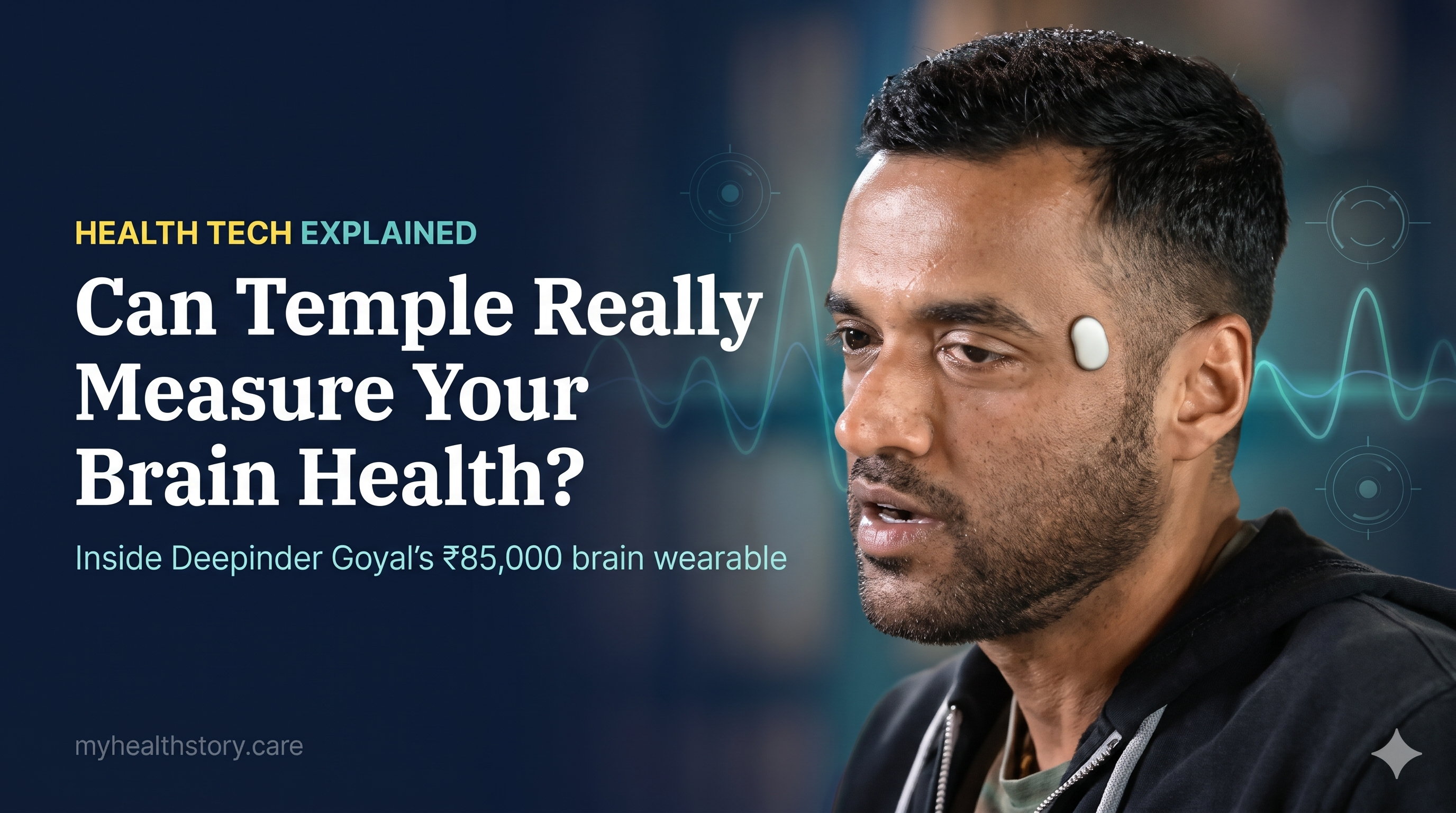
What if your smartwatch could tell you more than your heart rate, steps and sleep? What if a tiny device attached to the side of your head could continuously monitor signals associated with blood flowing to your brain?
That is the idea behind Temple, a wearable technology initiative founded by Deepinder Goyal, the entrepreneur best known for building Zomato.
Unlike conventional fitness trackers worn on the wrist or finger, Temple sits near the temple, between the forehead and the ear. Its ambition is to measure physiological signals that ordinary consumer wearables cannot easily capture.
The device has attracted international attention, scientific interest and considerable criticism from doctors. At approximately ₹85,000, it is also a premium experiment in consumer health technology.
But what does Temple actually measure? Can it tell whether your brain is receiving enough blood? And is there scientific evidence behind the idea that gravity could contribute to ageing?
Let's examine the technology, the research and the unanswered questions.
What is Temple, and why is Deepinder Goyal building it?
Temple is a head-mounted wearable developed by Deepinder Goyal through his technology venture.
The idea emerged from his interest in neuroscience, ageing and cerebral blood flow. Goyal has explained that his interest in measuring blood flow to the brain developed during his search for ways to better understand Parkinson's disease, which affected his mother.
Traditional wearables primarily collect data from the wrist, finger or chest. These locations are useful for measuring heart rate, movement, sleep-related signals and other physiological parameters.
Temple explores a different location: the side of the head.
The company argues that the temple offers access to optical and physiological signals that could reveal information about circulation, heat regulation, physical strain and other aspects of the body's functioning.
The device is designed to be extremely small and lightweight. Reuters reported that it weighs less than two grams and measures under an inch in width.
The company has also described a broader ambition: building a personal device that could eventually combine health monitoring with AI-powered interaction.
In other words, Temple is not simply trying to build another fitness band. It is experimenting with a different place to collect information from the human body.
How does Temple work?
One of Temple's central technologies is called BrainFlow.
The device uses photoplethysmography (PPG), an optical sensing technique also used in consumer wearables such as smartwatches.
PPG works by shining light into tissue and detecting changes in the light that is reflected or transmitted. Blood absorbs light differently from surrounding tissue, so changes in blood volume can produce measurable variations in the optical signal.
Temple places these sensors near the temporal region of the head.
Its BrainFlow algorithm processes the signals to generate an index intended to track relative changes associated with cerebral blood flow.
There is an important distinction here: Temple does not directly photograph the brain's blood vessels or measure the absolute volume of blood reaching every region of the brain. It produces an optical, algorithm-derived measurement that researchers are comparing with established cerebrovascular measurement techniques.
The company also describes another metric called Entropy, intended to provide information about how hard the body is working to regulate heat and manage physiological strain.
Temple's longer-term vision includes detecting patterns associated with chewing, jaw clenching, snoring, sleep and voice. Its official vision also describes a microphone-free audio approach called "roomdeaf audio", intended to detect the wearer's own voice without recording the surrounding room.
These are ambitious possibilities, but each capability needs its own technical validation.
The Gravity Ageing Hypothesis: Can gravity make us age faster?
Perhaps the most unusual part of Goyal's initiative is not the wearable itself. It is the hypothesis that inspired some of its original research.
Goyal has proposed what he calls the Gravity Ageing Hypothesis.
The basic idea is that humans spend much of their lives sitting or standing, with the brain positioned above the heart. Gravity creates a hydrostatic pressure difference that the cardiovascular system must continually compensate for to maintain adequate blood supply to the brain.
The brain has sophisticated mechanisms called cerebral autoregulation that help maintain relatively stable blood flow despite changes in blood pressure and posture.
Goyal and his collaborators propose that small, repeated gravitational challenges over decades might contribute to changes in cerebral circulation and potentially influence ageing.
They particularly discuss the hypothalamus and brainstem, two regions involved in regulating essential functions such as metabolism, temperature, hormones and autonomic activity.
Importantly, this is not an established explanation for human ageing.
In November 2026, the paper Gravitational Stress, Cerebral Blood Flow, and Aging – A Hypothesis was published in the journal Ageing Research Reviews.
The publication is significant because it puts the proposed mechanism into the scientific literature and outlines ways researchers could investigate it. But it is a hypothesis paper, not an experimental demonstration that gravity accelerates ageing or that a wearable can prevent it.
The authors themselves emphasise that experiments are needed to test the proposal.
Has Temple's BrainFlow technology been scientifically tested?
Yes. There are early validation studies, although they should not be confused with proof of clinical usefulness.
One study, published as a preprint in September 2026, compared Temple's BrainFlow index with transcranial Doppler ultrasound (TCD).
TCD is an established technique that measures blood-flow velocity in major arteries supplying the brain.
The study involved 23 healthy adults who completed exercise and postural-change tests. The researchers reported a median within-person correlation of approximately 0.8 between Temple's BrainFlow index and measurements of middle cerebral artery blood-flow velocity.
This is an encouraging early result. It suggests that the wearable's readings followed the direction and timing of certain changes detected by the reference technique.
However, the study did not establish that Temple measures absolute cerebral blood flow. The researchers compared relative changes after normalising the signals, and they explicitly called for further studies to establish cerebral specificity and potential clinical applications.
A second study, listed on Temple's official research page as being in peer review, compared BrainFlow with depth-resolved time-domain near-infrared spectroscopy (TD-NIRS).
The study involved healthy young men and reported correlations of 0.84–0.91 with brain blood-volume changes, higher than the corresponding correlations with scalp blood volume.
This is particularly relevant because a sensor placed on the skin can pick up signals from both superficial tissues and deeper structures. Distinguishing these signals is one of the central challenges in non-invasive brain monitoring.
Both studies represent progress towards validation. Neither establishes that Temple can diagnose neurological disease or predict future cognitive decline.
Why are doctors questioning Temple?
The criticism is not simply about whether a wearable can detect a pulse.
The more difficult question is whether an optical signal collected from the skin near the temple accurately represents blood circulation inside the brain.
The temporal region contains superficial blood vessels, including the superficial temporal artery. A sensor placed there can detect changes in blood volume, but that does not automatically mean it can measure blood flow throughout the brain.
The brain receives blood through an extensive network of arteries, and circulation differs between regions. A single external measurement cannot automatically represent all these different vascular territories.
Doctors have also questioned whether the device's measurements can be interpreted as meaningful indicators of brain health.
A change in blood-flow-related signals does not necessarily indicate brain damage, cognitive decline or a disease process. Cerebral circulation is influenced by several factors, including blood pressure, carbon dioxide levels, posture, exercise and the body's own regulatory mechanisms.
Reuters reported in November 2026 that Indian doctors had raised concerns about the scientific evidence behind Temple's claims and called for greater scrutiny.
Goyal, in response, has clarified that Temple is a fitness and wellness device, not a medical diagnostic device. The company has also said that its BrainFlow and Entropy metrics are supported by emerging research and that further validation is planned.
This distinction is important. A wellness tracker can provide experimental information without being proven to diagnose or prevent disease.
What does Temple cost, and when will it be available?
Temple opened pre-orders on November 1, 2026.
Reuters reported a price of approximately ₹85,000, or around US$900, making it considerably more expensive than most consumer fitness trackers.
The device has been presented in six colour options, and early interest has extended beyond India. Reuters reported that the company had received orders from more than 62 countries by November 11, 2026.
Temple's official website currently describes the first-generation Temple 01 as expected to ship in early 2027.
Its premium positioning reflects the company's ambition to build a new category of wearable technology rather than compete only on conventional smartwatch features.
However, consumers should distinguish the device's advertised capabilities from features that have already been independently validated.
Could Temple change the future of health monitoring?
There is a genuine opportunity in measuring physiological signals that existing consumer devices do not routinely capture.
Continuous monitoring could help researchers understand how posture, exercise, sleep, temperature regulation and other conditions influence circulation and physiological strain.
For athletes, additional measurements could eventually help investigate performance and recovery. For neuroscience researchers, wearable sensors could potentially make it easier to study changes in cerebral circulation outside specialised laboratories.
But the real test is whether these measurements are reliable, repeatable and useful.
A new health metric becomes valuable only when researchers can establish what it measures, how accurately it measures it, what influences it and whether it helps answer a meaningful health question.
Temple also raises a broader question about the future of consumer technology: could the next generation of wearables move beyond counting steps and measuring heart rate towards continuously monitoring more complex aspects of human physiology?
That possibility is worth exploring.
The verdict: An interesting experiment, not a medical breakthrough yet
Deepinder Goyal's Temple is an unusual attempt to push wearable technology into a new area of physiological monitoring.
Its focus on the temple, BrainFlow measurements and the Gravity Ageing Hypothesis makes it different from conventional fitness trackers. The early validation studies provide a starting point for scientific investigation, but they do not establish that the device can diagnose brain conditions, prevent ageing or measure blood supply across the entire brain.
The most important next step is independent research, larger and more diverse participant groups, peer-reviewed validation and evidence that the metrics have practical value.
Temple may eventually contribute something meaningful to wearable health technology. Or some of its proposed applications may prove less useful than its creators expect.
For now, the most interesting part is the question it raises: What if the next big breakthrough in wearable technology isn't on your wrist, but right beside your brain?
References and further reading
Temple – Official vision and technology overview. https://temple.com/vision
Temple – Science and Research. Official research summaries and validation studies. https://temple.com/science-and-research
Kumar A, et al. (2026). Concordance Between a Temple-Worn Optical Wearable and Transcranial Doppler During Exercise and Postural Transitions in Healthy Adults. medRxiv. https://doi.org/10.64898/2026.09.02.26362022
Gulati D, et al. (2026). Evaluating Brain Flow Index from a temple-worn wearable against depth-resolved time-domain NIRS during head-down tilt and postural transitions in healthy young men. bioRxiv. https://doi.org/10.64898/2026.09.17.751664
van Rosmalen L, Kumar N, Goyal D, Panda S. (2026). Gravitational Stress, Cerebral Blood Flow, and Aging – A Hypothesis. Ageing Research Reviews. https://doi.org/10.1016/j.arr.2026.103444
Reuters (November 11, 2026). Indian billionaire, doctors spar over $900 brain blood-flow tracker Temple. https://www.reuters.com/business/healthcare-pharmaceuticals/indian-billionaire-doctors-spar-over-900-brain-blood-flow-tracker-temple-2026-11-11/
TechCrunch (February 27, 2026). After Zomato, Deepinder Goyal returns with a $54M brain-monitoring bet. https://techcrunch.com/2026/02/27/after-zomato-deepinder-goyal-returns-with-a-54m-brain-monitoring-bet/
Indian Express (November 12, 2026). Deepinder Goyal's Temple: Can a wearable really measure blood flow inside your brain? https://indianexpress.com/article/explained/explained-health/deepinder-goyal-temple-wearable-brain-blood-flow-accuracy-explained-10959263/
Editorial note: This is an independent science and technology explainer. Temple is a fitness and wellness product, not an established diagnostic or treatment device. Its experimental metrics should not be used to make medical decisions or replace professional evaluation.