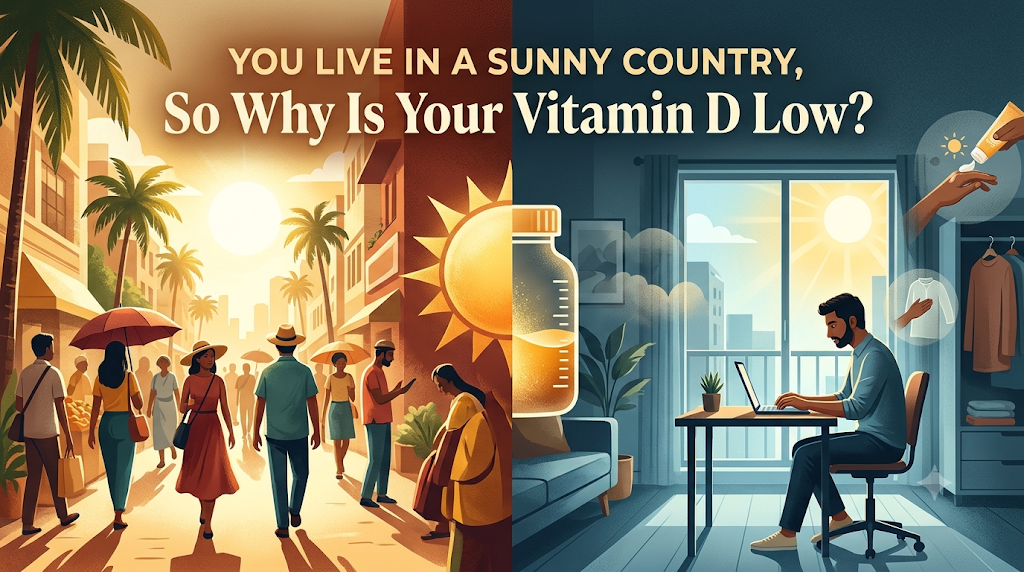
Picture this. For months you've felt slightly off. You're drained by four in the afternoon, there's a dull ache in your lower back, and your legs grumble every time you take the stairs. You blame work, age, or bad sleep.
Then the results of a routine health check-up arrive, and one line is flagged in red: Vitamin D (25-OH): 11 ng/mL — Deficient.
Your first reaction is probably disbelief. You live in India. The sun is out nearly every day of the year. How can you possibly be short of the "sunshine vitamin"?
If this sounds familiar, you have plenty of company. Study after study has found low vitamin D levels in Indians of every age, income group and region, including people who live in some of the sunniest parts of the country. The explanation is simpler than it seems: having sunshine around you is not the same as getting sunshine on your skin.
Let's look at what vitamin D actually does, why so many of us run low, and what you can sensibly do about it.
What exactly is vitamin D?
Vitamin D is an unusual nutrient. Unlike most vitamins, your body can make it on its own. When ultraviolet B (UVB) rays from the sun fall on bare skin, the skin produces vitamin D.
That raw vitamin D is inactive at first. The liver converts it into a form called 25-hydroxyvitamin D, which is what your blood test measures. The kidneys then turn it into the active form, which behaves more like a hormone than a vitamin.
Its best-known job is helping your gut absorb calcium and phosphorus from food. Without enough vitamin D, you can eat plenty of calcium and still not absorb much of it. Over time, bones can become thin, soft or misshapen. In children this shows up as rickets. In adults it can cause osteomalacia (softening of the bones) and contribute to osteoporosis.
Vitamin D also plays roles in muscle function, the immune system, inflammation and blood sugar control. Researchers have linked low levels to many conditions, from diabetes to depression. However, a link is not the same as a cause, and taking extra vitamin D has not been shown to prevent most of these diseases in otherwise healthy people. Its role in bone and muscle health is the part science is most sure about.
Why are so many Indians low on vitamin D despite all the sunshine?
There is rarely a single reason. In most people, several everyday factors add up.
1. We live most of our lives indoors
Think about a typical weekday. You wake up indoors, travel in a car, bus or metro, work under tube lights, and return home after sunset. Children spend their days in classrooms and tuition centres, and their evenings on screens.
Even when we do step out, it is often early in the morning or late in the evening. At those hours the sun's UVB rays are weak, so the skin makes very little vitamin D. Sunlight through a window does not help either, because ordinary glass blocks UVB.
2. Darker skin needs more time in the sun
Melanin, the pigment that gives skin its colour, works like a natural sunscreen. It protects the skin, but it also slows down vitamin D production. People with brown or darker skin generally need longer sun exposure to make the same amount of vitamin D as people with lighter skin.
3. We cover up
Full-sleeved clothing, dupattas, sarees, burqas, umbrellas and sunscreen all limit how much skin the sun can reach. Many of these choices are cultural, religious or practical, and some are driven by a preference for fairer skin. Whatever the reason, the effect is the same. This is one reason women in India tend to be more affected than men.
4. Pollution and tall buildings block the sun
In many Indian cities, smog and dust filter out a good share of UVB before it reaches the ground. Densely packed buildings and narrow lanes add shade. So a hazy winter afternoon in Delhi gives your skin far less vitamin D than the same hour on a clear day.
5. Our diets contain very little vitamin D
Very few foods naturally contain meaningful amounts of vitamin D. The best sources are fatty fish and egg yolks. A typical vegetarian meal of dal, rice, roti and sabzi contains almost none.
Fortified foods can fill this gap, but in India only some brands of milk and edible oil are fortified, and not everyone uses them. Low calcium intake can make matters worse, because the body uses up its vitamin D faster when calcium is short.
6. Body weight, age and health conditions
Some people are at higher risk because of their health:
Excess body weight: vitamin D is stored in body fat, so people with obesity tend to have lower blood levels.
Older age: ageing skin makes vitamin D less efficiently.
Gut conditions: coeliac disease, inflammatory bowel disease and weight-loss surgery can reduce absorption.
Liver or kidney disease: these organs are needed to activate vitamin D.
Certain medicines: some anti-seizure drugs, long-term steroids and a few others can lower vitamin D levels.
Why low vitamin D can go unnoticed for years
Most people with low vitamin D feel nothing unusual. The body adapts quietly, and bones lose strength slowly, over years. That is why many people only find out from a routine blood test, or after a fracture.
When symptoms do appear, they tend to be vague:
Tiredness that doesn't improve with rest
Aches in the bones, especially the lower back, hips, legs or ribs
Muscle weakness, cramps, or difficulty getting up from a chair or climbing stairs
Fractures after a minor fall
In children: bowed legs, delayed growth or late teething
Here is the catch. None of these symptoms is specific to vitamin D. Fatigue and body aches are just as likely to come from anaemia, thyroid problems, vitamin B12 deficiency, poor sleep, diabetes or stress. So if you feel unwell, it is worth seeing a doctor rather than assuming a vitamin D sachet will fix everything.
How do doctors check your vitamin D levels?
A simple blood test called 25-hydroxyvitamin D, or 25(OH)D, is the standard way to measure vitamin D status. Results are reported in ng/mL or nmol/L (1 ng/mL equals 2.5 nmol/L).
The US National Institutes of Health uses these broad bands:
Blood level (ng/mL)
Blood level (nmol/L)
What it generally means
Below 12
Below 30
Deficient
12 to 19
30 to 49
Inadequate for bone and overall health in some people
20 and above
50 and above
Adequate for most healthy people
Above 50
Above 125
Possibly too high; linked to potential harm
You may notice that many Indian lab reports print a different range, often calling 30 to 100 ng/mL "sufficient". Different laboratories and medical societies use different cut-offs. That is one reason headlines about vitamin D deficiency in India quote such different numbers. A value of 22 ng/mL may be flagged as "insufficient" on your report while still being adequate by other standards. Your doctor can interpret it in the context of your health.
Does everyone need a vitamin D test?
Not necessarily. In 2024, the Endocrine Society, a leading international body of hormone specialists, recommended against routine vitamin D testing for most healthy adults under 75. The evidence did not show that testing everyone improves health outcomes.
Testing does make sense when there is a clear reason, for example:
Bone pain, osteoporosis or unexplained fractures
Conditions that affect absorption, such as coeliac disease or past bariatric surgery
Chronic kidney or liver disease
Long-term use of medicines that lower vitamin D
Abnormal calcium levels on other tests
Because deficiency is so common in India, many doctors here test more freely. If you are unsure, ask your doctor whether a test will actually change what you do next.
Can low vitamin D be corrected?
Yes, and in most cases it is one of the easier problems to fix. If your levels are genuinely low, your doctor will usually prescribe vitamin D3 (cholecalciferol). Depending on how low you are and your overall health, it may be given daily, weekly or monthly for a set period, followed by a smaller maintenance dose. If your diet is low in calcium, a calcium supplement may be added.
Your doctor may repeat the blood test after a few months to check that the treatment is working. Many people notice their aches and tiredness ease as levels recover, although this varies from person to person.
A word of caution about the 60,000 IU sachet
In India, high-dose vitamin D sachets and capsules (often 60,000 IU) are cheap and easy to buy without a prescription. Many people start taking them weekly on a friend's advice and simply never stop. Some take them alongside multivitamins and calcium tablets that also contain vitamin D, without realising they are doubling up.
This matters because vitamin D is fat-soluble, which means the body stores it rather than flushing out the excess. Too much can push blood calcium dangerously high. A study from a hospital in Delhi-NCR described 16 patients with vitamin D toxicity, all caused by mega-doses. Their symptoms included nausea, vomiting, constipation, confusion, pancreatitis and kidney damage.
With vitamin D, more is not better. Take only the dose your doctor recommends, for as long as they recommend it. Tell them about every supplement you take, including combination products.
What everyday changes can help?
Supplements correct a deficiency. Daily habits help keep it from coming back. For most healthy adults, the ICMR–National Institute of Nutrition recommends 600 IU (15 micrograms) of vitamin D a day, together with regular sun exposure.
Get sunlight on your skin, sensibly. Short spells of sun on your arms, legs or back in the late morning or early afternoon, a few times a week, are more useful than long walks at dawn. Fifteen to thirty minutes is often enough, but people with darker skin may need longer. Avoid getting sunburnt, and remember that sitting by a window doesn't count.
Combine sun with movement. A brisk outdoor walk at lunchtime, a game of badminton on the terrace, or gardening gives you sunlight and exercise at once, and both are good for your bones.
Eat the foods that do contain vitamin D. If you eat non-vegetarian food, include fatty fish such as salmon, mackerel or sardines, and whole eggs (the vitamin D is in the yolk). Mushrooms that have been exposed to sunlight or UV light also contain some.
Choose fortified foods. Look for the +F logo from FSSAI on milk and edible oil packets. It shows the product has been fortified with added vitamins, which can include vitamin D.
Don't forget calcium. Milk, curd, paneer, ragi, sesame seeds and green leafy vegetables help vitamin D do its job.
Keep a healthy weight. Losing excess weight can help raise vitamin D levels, alongside its many other benefits.
If you're pregnant, breastfeeding, over 70, or caring for an infant, needs are different. Ask your doctor or paediatrician what's right for you.
Why should India pay attention to vitamin D?
Exactly how many Indians are deficient depends on who is tested and which cut-off is used. Several older studies put the figure at 70 to 90 percent of the population. A 2025 report by the think tanks ICRIER and the ANVKA Foundation, using a stricter definition, estimated that about one in five Indians is deficient, rising to nearly 39 percent in eastern India.
Either way, we are talking about hundreds of millions of people. The groups most affected are children and adolescents, pregnant women, older adults and women in general.
The long-term cost is felt mainly in our bones. Children need vitamin D to build a strong skeleton. Adults need it to keep that skeleton strong as they age. As India's population grows older, weak bones and fractures from osteoporosis will place a growing burden on families and on the health system. Food fortification and public awareness are slowly improving, but individual habits still matter a great deal.
The bigger lesson: sunshine is free, but you have to step into it
Low vitamin D in a sunny country is not really a mystery. It reflects the way many of us now live: indoors, seated, covered up, in polluted cities, on diets that contain little of this nutrient.
The good news is that it is usually easy to correct. A few minutes of midday sun, an outdoor walk, sensible food choices and, when needed, a supplement taken under medical advice can make a real difference. What doesn't help is panic, or swallowing high-dose sachets indefinitely without guidance.
So the next time your report flags a low vitamin D level, don't ignore it and don't overreact. Talk to your doctor, find out what the number means for you, and then go and spend some time in the sun.
Your vitamin D level is less a verdict on your health than a reminder to get outside more often.
Medical note: This article is for general education only. It does not replace consultation with a qualified doctor. Please seek medical advice before starting, stopping or changing any supplement or treatment.
References and further reading
Office of Dietary Supplements, US National Institutes of Health. Vitamin D: Fact Sheet for Health Professionals.
Demay MB, et al. Vitamin D for the Prevention of Disease: An Endocrine Society Clinical Practice Guideline. J Clin Endocrinol Metab. 2024. doi:10.1210/clinem/dgae290
ICMR–National Institute of Nutrition. Nutrient Requirements for Indians: Recommended Dietary Allowances and Estimated Average Requirements. 2020.
ICRIER and ANVKA Foundation. Roadmap to Address Vitamin D Deficiency in India. 2025. Coverage in ThePrint.
Aparna P, et al. Vitamin D deficiency in India. J Family Med Prim Care. 2018;7(2):324–330.
Kaur P, Mishra SK, Mithal A. Vitamin D toxicity resulting from overzealous correction of vitamin D deficiency. Clin Endocrinol (Oxf). 2015;83(3):327–331.
MedlinePlus, US National Library of Medicine. Vitamin D.