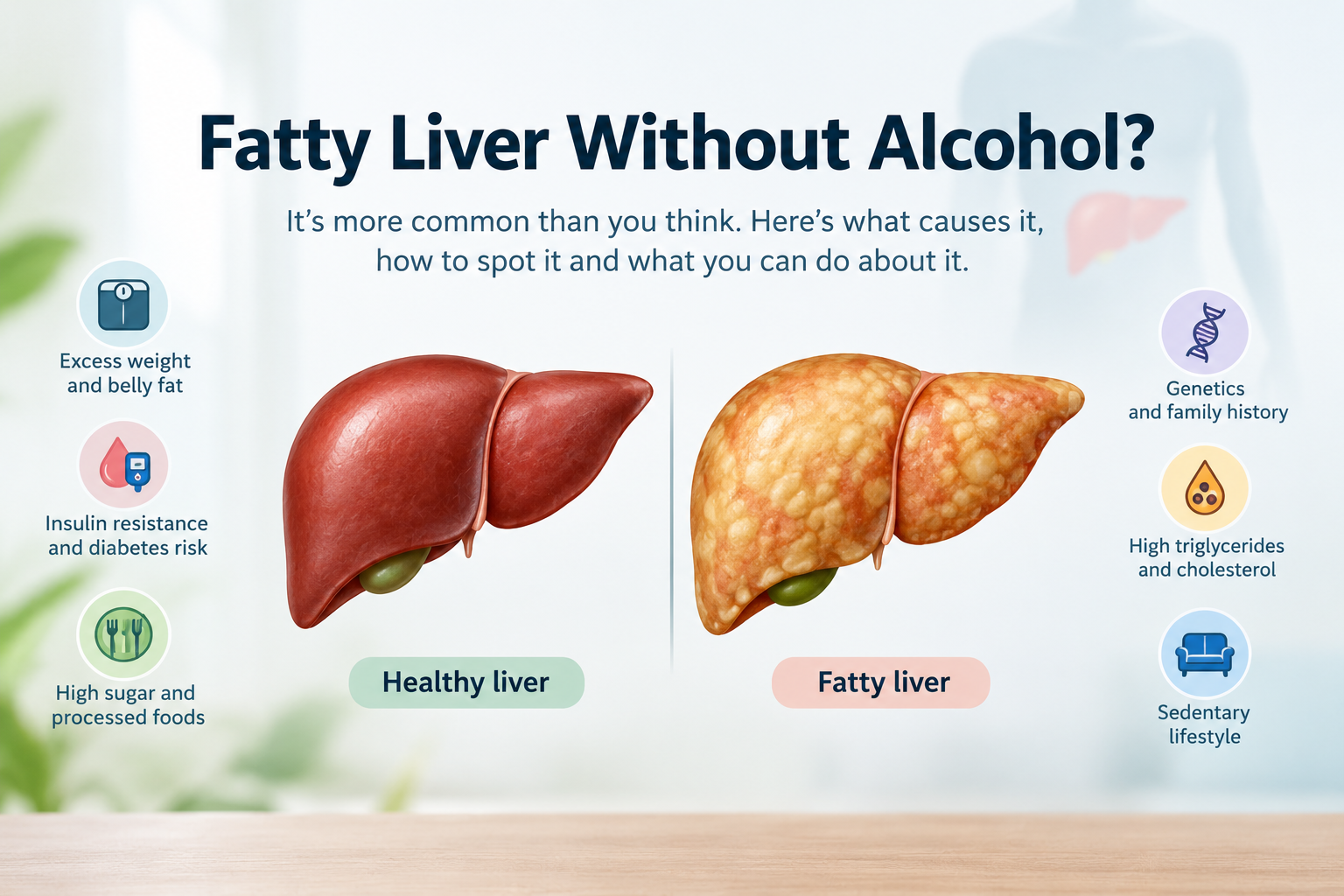
Imagine going for a routine health check-up. You rarely drink alcohol, don't smoke, and generally consider yourself healthy. But your ultrasound report contains an unexpected finding: Grade 1 fatty liver.
The first question that comes to mind is probably: How can I have fatty liver when I don't drink?
The answer lies in something many people overlook: fatty liver is not just an alcohol-related condition. It is closely connected to how the body processes energy, stores fat and regulates blood sugar.
In fact, metabolic health has become one of the major areas of concern in liver disease research, particularly in countries such as India.
What exactly is fatty liver?
Fatty liver occurs when excess fat accumulates inside liver cells. A small amount of fat in the liver is normal, but excessive accumulation can become a health concern.
The condition was traditionally called non-alcoholic fatty liver disease (NAFLD). Medical organisations now increasingly use the term metabolic dysfunction-associated steatotic liver disease (MASLD).
MASLD describes fatty liver associated with at least one cardiometabolic risk factor, such as excess body weight, abnormal blood sugar, high triglycerides or elevated blood pressure, in the absence of harmful alcohol consumption.
It is not a single stage of disease. Some people have fat accumulation without significant liver injury, while others develop inflammation and eventually scarring.
The more advanced inflammatory form is called metabolic dysfunction-associated steatohepatitis (MASH), previously known as NASH. Over time, significant scarring can progress to cirrhosis.
Why do people who don't drink alcohol develop fatty liver?
The liver plays a central role in processing carbohydrates, fats and proteins. When the body's metabolic processes become disrupted, fat can accumulate in the liver even without alcohol consumption.
Here are some important contributing factors.
1. Insulin resistance
Insulin helps regulate blood glucose and influences how the body stores and uses energy.
When the body becomes resistant to insulin, the pancreas may produce more of it to maintain blood glucose levels. Insulin resistance is also associated with increased fat delivery to the liver and changes in how the liver produces and stores fat.
This is one reason fatty liver frequently occurs alongside prediabetes and type 2 diabetes.
Importantly, someone can develop insulin resistance before being diagnosed with diabetes.
2. Belly fat and excess body weight
Not all body fat behaves in the same way.
Visceral fat, which accumulates around internal abdominal organs, is metabolically active. It releases fatty acids and signalling molecules that can contribute to insulin resistance and metabolic disturbances.
These changes can increase fat accumulation in the liver.
However, there is an important exception: you do not have to be visibly overweight to develop fatty liver.
People with a normal body weight can also develop MASLD, particularly when they have abdominal fat accumulation, insulin resistance or other metabolic risk factors. This is sometimes called lean MASLD.
3. Excessive sugar and refined carbohydrates
Regularly consuming large amounts of sugary beverages, sweets and highly refined carbohydrate-rich foods can contribute to excess calorie intake and metabolic dysfunction.
The liver can convert excess carbohydrate into fat through a process called de novo lipogenesis.
Fructose, found naturally in fruits and also in added sugars such as high-fructose syrups, is particularly relevant to liver fat metabolism.
This does not mean that eating one sweet or one fruit causes fatty liver. The overall dietary pattern, energy balance and metabolic health matter much more than one individual food.
4. High triglycerides and abnormal cholesterol
Triglycerides are a type of fat circulating in the bloodstream.
Elevated triglycerides and low HDL cholesterol often occur alongside insulin resistance and other metabolic risk factors. These abnormalities can indicate a broader metabolic problem that is also associated with fatty liver.
This is why doctors may assess cholesterol, triglycerides, blood pressure and blood glucose when investigating a fatty liver finding.
5. Genetics and family history
Genetics can influence how the body stores fat in the liver and how susceptible someone is to liver inflammation and scarring.
Certain genetic variations, including those involving PNPLA3, have been associated with increased susceptibility to fatty liver disease.
This helps explain why two people with similar diets and lifestyles may have very different liver-health outcomes.
Why fatty liver can go unnoticed for years
One of the challenging aspects of fatty liver is that it often develops without noticeable symptoms.
Many people discover it accidentally during an ultrasound performed for an unrelated reason.
Some people may experience fatigue or discomfort in the upper-right abdomen, but these symptoms are not specific enough to diagnose fatty liver.
More importantly, the absence of symptoms does not necessarily mean the liver is healthy.
A person may have significant liver scarring without obvious warning signs. This is why assessing the risk of fibrosis, rather than focusing only on the amount of fat, is important.
How do doctors diagnose fatty liver?
Doctors may use a combination of medical history, blood tests and imaging.
Ultrasound: An abdominal ultrasound can identify signs of fat accumulation in the liver. However, it cannot reliably determine whether inflammation or fibrosis is present.
Liver function tests: Blood tests measuring ALT and AST can help identify possible liver injury. However, normal liver enzyme levels do not completely rule out significant liver disease.
FIB-4 score: This is a calculation based on age, AST, ALT and platelet count. Doctors use it as an initial tool to estimate the likelihood of advanced liver fibrosis.
FibroScan or elastography: These tests assess liver stiffness and can help identify people who may have significant fibrosis.
A liver biopsy is sometimes required in selected cases, but it is not necessary for everyone with fatty liver.
A fatty liver finding should therefore not be interpreted using an ultrasound grade alone. A doctor needs to assess the overall metabolic and liver-health picture.
Can fatty liver be reversed?
This is perhaps the most encouraging part of the research.
In many people, particularly those with early-stage disease, liver fat can decrease significantly with sustained lifestyle changes.
The 2024 clinical guidelines from the European Association for the Study of the Liver, European Association for the Study of Diabetes and European Association for the Study of Obesity recommend weight management, dietary improvement and physical activity as central parts of MASLD treatment.
For adults with MASLD who are overweight, the guidelines describe the following sustained weight-loss targets:
Around 5% reduction in body weight may reduce liver fat.
Around 7–10% may improve liver inflammation.
A reduction of 10% or more may improve liver fibrosis in some people.
These are treatment targets, not guaranteed outcomes. Results vary depending on disease stage and individual circumstances.
What changes can help improve liver health?
1. Reduce sugary drinks and excess added sugar.
Replace regular soft drinks, sweetened juices and other sugary beverages with water or unsweetened alternatives.
2. Improve the overall quality of your diet.
Include vegetables, whole grains, pulses, nuts, appropriate protein sources and healthy fats. Reduce excessive intake of highly processed foods and calorie-dense meals.
3. Exercise consistently.
Walking, cycling, swimming and resistance training can improve metabolic health. Physical activity can benefit liver fat even when substantial weight loss does not occur.
4. Manage blood sugar and cholesterol.
If you have diabetes, prediabetes, high triglycerides or hypertension, managing these conditions is an important part of protecting your liver.
5. Avoid relying on liver detox products.
There is no reliable scientific basis for claims that commercial detox drinks or herbal mixtures cleanse the liver. Some supplements can actually cause liver injury.
Do not stop prescribed medication or begin supplements without consulting your doctor.
Why should India pay attention to fatty liver?
India is experiencing a growing burden of metabolic diseases, including diabetes, obesity and cardiovascular conditions.
The Ministry of Health and Family Welfare's operational guidelines for non-alcoholic fatty liver disease highlight its association with these conditions and estimate that up to one-third of Indian adults may be affected.
Changing dietary patterns, sedentary lifestyles and metabolic risk factors make fatty liver an important public-health concern.
The condition should not be viewed as a problem affecting only people who drink alcohol or people with obesity. It deserves attention as part of the broader conversation about metabolic health.
The bigger lesson: Your liver reflects your metabolic health
Fatty liver without alcohol consumption is not unusual, and it is not necessarily a sign of irreversible damage.
It can be an early indication that something in the body's metabolic system needs attention.
Instead of panicking over an ultrasound report, the more useful approach is to understand why fat has accumulated, assess whether fibrosis is present, and address the underlying risk factors.
Your liver does not need a miracle detox. It needs a healthier metabolic environment, consistent habits and appropriate medical care.
Sometimes, the most important health warning is the one you discover before you feel anything is wrong.
References and further reading
Ministry of Health and Family Welfare, Government of India. Operational Guidelines for Non-Alcoholic Fatty Liver Disease, Version 2.0, September 2024.
EASL–EASD–EASO. Clinical Practice Guidelines on the Management of Metabolic Dysfunction-Associated Steatotic Liver Disease. Journal of Hepatology, 2024. https://doi.org/10.1016/j.jhep.2024.04.031
Rinella ME et al. A multisociety Delphi consensus statement on new fatty liver disease nomenclature. Hepatology, 2023. https://doi.org/10.1097/HEP.0000000000000520
National Institute of Diabetes and Digestive and Kidney Diseases (NIDDK). Diagnosis of NAFLD and NASH. https://www.niddk.nih.gov/health-information/liver-disease/nafld-nash/diagnosis
Medical note: This article is intended for general educational purposes and does not replace a medical consultation or individual diagnosis.