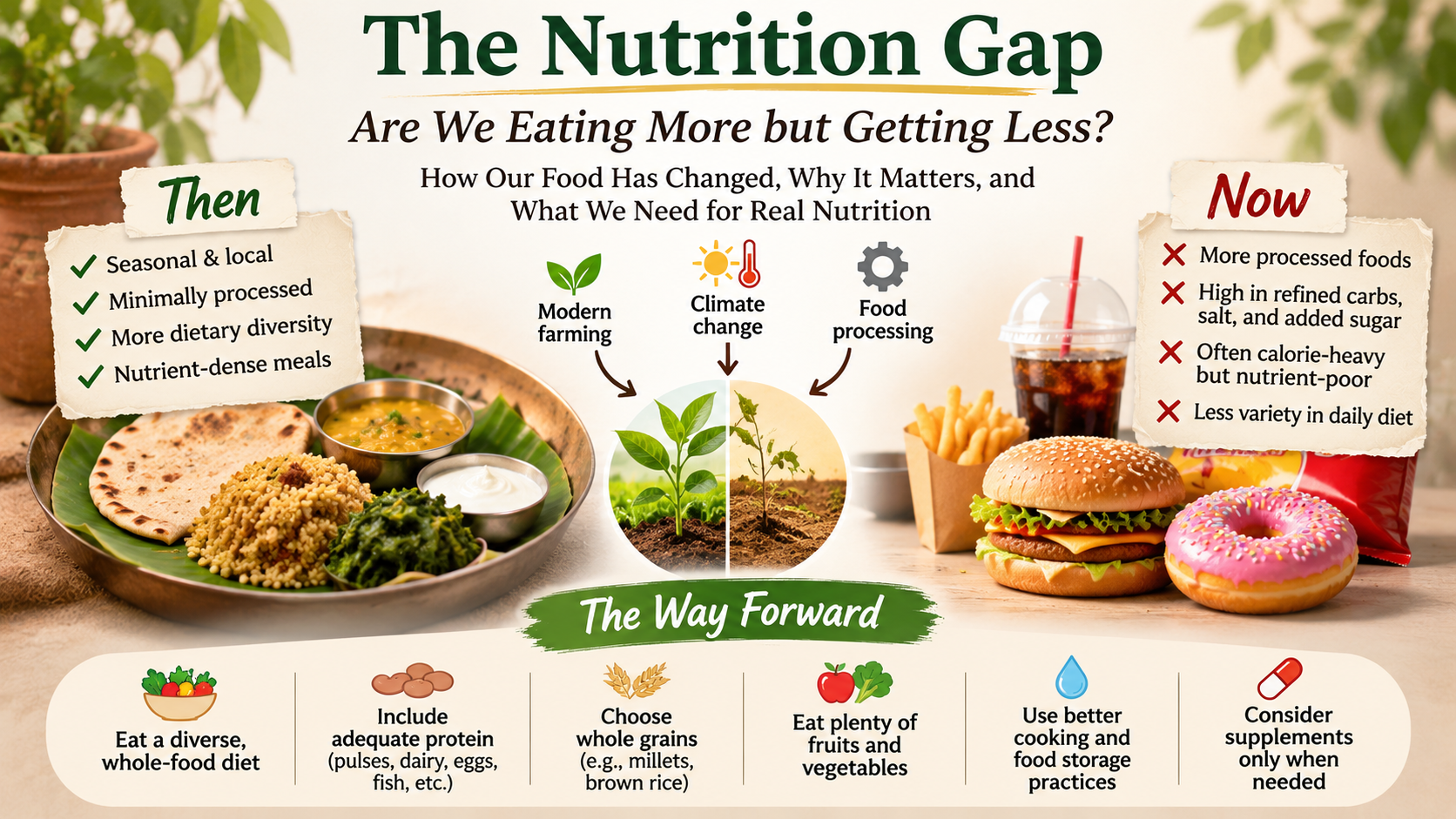
Our grandparents ate seasonal vegetables, fresh grains, pulses, homemade curd and food prepared at home. Today, we have supermarkets filled with fruits, vegetables, fortified products, protein bars, health drinks and nutritional supplements. We have more food choices than ever before. Yet nutritional deficiencies, obesity and metabolic diseases remain major public-health concerns. So what exactly has changed? Have our foods lost their nutritional value, or have we lost the ability to eat properly? The scientific answer is more complicated—and more interesting—than we think.
1. The paradox of modern nutrition: Full stomachs, undernourished bodies
Imagine two people.
The first eats three substantial meals every day. Rice, bread, packaged snacks, sweetened beverages and occasional restaurant food make up most of the diet. They rarely feel hungry.
The second eats smaller portions but includes vegetables, fruits, pulses, eggs, dairy, nuts, whole grains and other sources of essential nutrients.
Both may consume enough calories to maintain their body weight.
But are they receiving the same nutrition?
Absolutely not.
The human body needs more than calories. It requires proteins, essential fatty acids, vitamins, minerals, dietary fibre and numerous other compounds that support biological functions.
Calories provide energy. Nutrients help the body use that energy, repair tissues, maintain immunity, produce hormones, support brain function and sustain healthy organs.
This distinction is central to understanding modern nutrition.
A person can consume more than enough calories while remaining deficient in iron, vitamin B12, folate or other essential nutrients.
This is sometimes described as the double burden of malnutrition: undernutrition and micronutrient deficiencies can coexist with overweight, obesity and diet-related non-communicable diseases, even within the same population or household.
The World Health Organization recognises malnutrition as a broad condition that includes undernutrition, micronutrient-related malnutrition, overweight and obesity.
The problem, therefore, is not simply whether we are eating enough.
It is whether the food we consume meets our body's nutritional requirements.
Scientific reference: WHO, Malnutrition – Fact Sheet.
https://www.who.int/news-room/fact-sheets/detail/malnutrition
2. What did people eat earlier, and what has changed?
To understand today's nutritional challenges, we need to examine how food consumption has changed over generations.
There is a common perception that previous generations ate healthier because their food was natural, locally grown and minimally processed.
There is some truth to this observation, particularly when we examine traditional dietary patterns.
In many Indian households, everyday meals historically revolved around:
Rice, wheat, millets and other locally available cereals.
Pulses such as dal, chickpeas, lentils and green gram.
Seasonal vegetables and green leafy vegetables.
Locally available fruits.
Milk, curd and buttermilk where dairy was part of the diet.
Groundnuts, sesame and other locally available nuts and seeds.
Fish, eggs and meat in communities where these were regularly consumed.
Fermented foods, pickles and other traditional preparations.
Meals were often prepared at home using familiar ingredients. Food availability was also influenced by agricultural seasons, regional geography and local food traditions.
But we should not romanticise the past.
Earlier generations also experienced food scarcity, protein-energy malnutrition, vitamin deficiencies, poor sanitation, infections and limited access to healthcare. Many households could not afford a diverse diet.
Food insecurity was a major reality.
Modern agriculture, food distribution, refrigeration, food safety systems, fortification and improved transportation have brought enormous benefits. They have made many foods more accessible throughout the year.
The problem is that the transformation of our food system has also changed what people consume.
Today, convenience frequently determines food choices.
A working individual may consume:
Refined rice or white bread as the primary carbohydrate source.
Packaged breakfast cereals or biscuits.
Instant noodles and ready-to-eat meals.
Sweetened tea, coffee and beverages.
Deep-fried snacks.
Restaurant meals containing substantial amounts of salt, oil and refined carbohydrates.
Very limited quantities of fruits, vegetables, pulses and nuts.
This is not the experience of every Indian household, but the transition towards convenience-oriented eating is an important public-health concern.
The ICMR-NIN report What India Eats examined dietary consumption patterns in India and found that cereals and fats contributed substantially to energy intake, while several protective food groups, including pulses, vegetables, fruits, nuts and milk products, were consumed below recommended levels in many population groups.
The important finding is not that Indians have stopped eating traditional food.
It is that the balance between food groups has become a concern.
Scientific reference: ICMR-National Institute of Nutrition, What India Eats (2020).
https://www.nin.res.in/nutrition2020/what_india_eats.pdf
3. Have fruits and vegetables actually lost their nutritional value?
This is where the discussion becomes particularly interesting.
You may have encountered claims such as:
Vegetables today contain fewer minerals than they did 50 years ago.
Modern fruits contain less vitamin content.
Intensive farming has depleted all the nutrients from agricultural soil.
A person must eat several times more vegetables today to receive the same nutrition as previous generations.
Are these claims scientifically established?
Not entirely.
There is published research suggesting that the nutrient composition of some crops has changed over time. However, the evidence is not sufficiently consistent to conclude that all modern fruits and vegetables have become nutritionally inferior.
One frequently cited study was published in the Journal of the American College of Nutrition in 2004.
Researchers Donald R. Davis, Melvin Epp and Hugh Riordan compared USDA food-composition data for 43 garden crops between 1950 and 1999.
They identified statistically reliable group-level declines in six nutrients:
Protein.
Calcium.
Phosphorus.
Iron.
Riboflavin.
Ascorbic acid (vitamin C).
The reported median declines ranged from approximately 6% for protein to 38% for riboflavin.
At first glance, these findings sound alarming.
But the researchers also identified important limitations.
For individual food-and-nutrient comparisons, many apparent differences were not statistically distinguishable from no change. Some nutrient values actually increased.
They suggested that changes in cultivated crop varieties, particularly breeding for higher yields, could explain some of the observed differences.
This phenomenon is often called the dilution effect.
What is the dilution effect?
Imagine two varieties of wheat.
One produces a relatively smaller quantity of grain but contains a higher concentration of certain minerals.
Another produces significantly more grain but does not increase its mineral content proportionately.
The second variety may provide more total food, but its mineral concentration per unit of grain could be lower.
This does not mean the crop has become nutritionally empty. It means that increasing agricultural productivity and increasing nutrient concentration are not always the same objective.
Modern plant breeding has historically placed considerable emphasis on yield, disease resistance, appearance, storage and other agricultural characteristics.
Nutrient density is another important breeding objective, but it has not always received equal attention.
However, we must also consider another scientific perspective.
In a 2017 review published in the Journal of Food Composition and Analysis, Robin J. Marles critically examined claims of widespread historical mineral depletion in vegetables, fruits and grains.
The review highlighted problems with comparing historical food-composition databases, including differences in:
Crop varieties.
Geographic origin.
Soil conditions.
Sample sizes.
Ripeness.
Laboratory methods.
Analytical techniques.
The author argued that some widely publicised claims of widespread mineral depletion were not adequately supported.
This distinction is essential.
There is evidence that crop genetics and growing conditions can influence nutrient concentration. There is not convincing evidence that every modern fruit or vegetable has lost a substantial proportion of its nutritional value.
Scientific references:
Davis DR, Epp MD, Riordan HD. (2004). Changes in USDA Food Composition Data for 43 Garden Crops, 1950 to 1999. Journal of the American College of Nutrition.
https://doi.org/10.1080/07315724.2004.10719409
Marles RJ. (2017). Mineral nutrient composition of vegetables, fruits and grains: The context of reports of apparent historical declines. Journal of Food Composition and Analysis.
https://doi.org/10.1016/j.jfca.2016.11.012
4. The climate connection: Can rising carbon dioxide make crops less nutritious?
One of the most important developments in nutritional science concerns something that may seem completely unrelated to food quality: atmospheric carbon dioxide.
Plants use carbon dioxide during photosynthesis.
As atmospheric carbon dioxide concentrations increase, many plants can produce more carbohydrates under suitable growing conditions.
However, this does not necessarily mean that their concentrations of protein and essential minerals increase proportionately.
Scientists have investigated whether elevated atmospheric CO2 can change the nutritional composition of important food crops.
A landmark paper published in Nature in 2014 by researchers including Samuel Myers and colleagues examined this issue.
Their research found that elevated carbon dioxide concentrations could reduce zinc and iron concentrations in several C3 crops, including wheat, rice and legumes.
These crops are important dietary sources of essential micronutrients for billions of people.
The research raised an important concern: food production may remain adequate in terms of calories while the nutritional composition of certain crops changes.
What about rice?
This is particularly relevant to India and other rice-consuming countries.
In 2018, Chunwu Zhu and colleagues published a study in Science Advances examining the effects of elevated carbon dioxide on rice.
The researchers conducted multi-year, multi-location field experiments involving 18 rice varieties using free-air CO2 enrichment technology.
Under elevated CO2 conditions, they observed average reductions of approximately:
10.3% in protein.
8.0% in iron.
5.1% in zinc.
They also found reductions in several B vitamins, including B1, B2, B5 and B9, while vitamin E increased.
These findings are scientifically significant because rice is a major source of dietary energy for large populations across Asia.
However, there is an important qualification.
These were experimental comparisons under elevated carbon dioxide conditions designed to investigate future climate scenarios. They do not demonstrate that all rice currently sold in Indian markets has already lost these exact percentages of nutrients.
The results also varied across nutrients and crop varieties.
Nevertheless, they establish that climate change can influence the nutritional quality of food, not merely the quantity of food produced.
Scientific references:
Myers SS et al. (2014). Increasing CO2 threatens human nutrition. Nature.
https://doi.org/10.1038/nature13179
Zhu C et al. (2018). Carbon dioxide (CO2) levels this century will alter the protein, micronutrients, and vitamin content of rice grains with potential health consequences for the poorest rice-dependent countries. Science Advances.
https://doi.org/10.1126/sciadv.aaq1012
5. Is agricultural soil losing its nutritional value?
Another popular explanation for declining food quality is soil depletion.
The argument is that modern intensive farming removes minerals from agricultural soil faster than they can be replenished, eventually producing nutritionally inferior crops.
Soil health is unquestionably important.
Plants require essential mineral elements such as nitrogen, phosphorus, potassium, calcium, magnesium, iron and zinc for healthy growth.
Agricultural practices can influence soil organic matter, nutrient availability, soil structure and biological activity.
Poor nutrient management, erosion and degradation can negatively affect agricultural productivity and crop quality.
But there is a distinction between soil degradation and the claim that all agricultural soils have become mineral-deficient.
The 2017 review by Marles discussed evidence showing that historical comparisons of crop mineral composition cannot automatically be attributed to widespread soil mineral depletion.
Crop genetics, fertiliser management, soil conditions and agricultural practices all interact.
It is therefore inaccurate to claim that modern agricultural soil has universally lost its minerals and that this is why today's vegetables are nutritionally empty.
What should sustainable agriculture focus on?
A better approach is to improve soil health while also considering the nutritional characteristics of crops.
This includes:
Maintaining soil organic matter.
Using appropriate crop rotations.
Applying balanced fertilisers based on soil testing.
Preventing erosion.
Improving water management.
Supporting soil microbial activity.
Developing crop varieties with improved nutrient density.
Agriculture should not be measured only by tonnes of grain produced per hectare.
The nutritional quality of those tonnes matters too.
6. The processing problem: When convenience replaces nutritional diversity
The decline in dietary quality cannot be explained by crop composition alone.
One of the major changes in modern food consumption is the growing availability and consumption of highly processed foods.
Not all processing is harmful.
Pasteurisation makes milk safer. Freezing helps preserve food. Fermentation can improve digestibility and flavour. Fortification can improve the intake of nutrients that may otherwise be lacking.
The problem is particularly associated with certain formulations of ultra-processed foods.
The NOVA classification system groups foods according to the extent and purpose of processing. Ultra-processed foods commonly include industrial formulations containing ingredients and additives not typically used in ordinary home cooking.
Examples can include:
Sugary soft drinks.
Packaged sweet biscuits.
Certain breakfast cereals.
Instant noodles.
Many confectionery products.
Some packaged savoury snacks.
Reconstituted meat products.
Certain ready-to-eat meals.
Not every food in a packet is ultra-processed, and not every processed food is nutritionally poor.
The actual nutritional composition matters.
However, many ultra-processed products are designed to be convenient, highly palatable and easy to consume in large quantities. Some contain substantial amounts of added sugar, sodium and unhealthy fats while providing relatively little fibre.
What does the research say?
A particularly important study was published in Cell Metabolism in 2019.
Kevin Hall and colleagues conducted a controlled inpatient randomised crossover trial involving 20 adults.
Participants received either an ultra-processed diet or an unprocessed diet for two weeks, followed by the alternative diet.
The diets were designed to be matched for presented calories, macronutrients, sugar, sodium and fibre.
Despite these efforts, participants consumed approximately 500 additional calories per day during the ultra-processed diet and gained weight. They lost weight during the unprocessed diet.
The experiment provides evidence that the characteristics of ultra-processed diets can influence spontaneous energy intake and body weight.
It does not prove that every ultra-processed food independently causes obesity or that processing alone explains every nutritional problem.
But it demonstrates why the overall structure of a diet matters.
Scientific reference: Hall KD et al. (2019). Ultra-Processed Diets Cause Excess Calorie Intake and Weight Gain: An Inpatient Randomized Controlled Trial of Ad Libitum Food Intake. Cell Metabolism.
https://doi.org/10.1016/j.cmet.2019.05.008
7. India's nutrition transition: What are we actually eating today?
India provides an interesting example of how food availability and nutritional quality can move in different directions.
The country has experienced enormous changes in urbanisation, employment, transportation, food distribution and household consumption.
In September 2025, a major study titled Dietary Profiles and Associated Metabolic Risk Factors in India from the ICMR–INDIAB Survey-21 was published in Nature Medicine.
The study examined dietary patterns and associated metabolic risk factors among 18,090 adults in India.
The researchers identified several concerning characteristics of Indian dietary patterns:
High intake of low-quality carbohydrates, including white rice, milled grains and added sugar.
Relatively high saturated-fat intake.
Low protein intake.
The researchers also examined the relationship between carbohydrate intake and metabolic risk.
People in the highest carbohydrate-intake category had higher odds of newly diagnosed type 2 diabetes, prediabetes, generalised obesity and abdominal obesity compared with those in the lowest category.
The study also modelled substitutions of carbohydrates with different protein sources and found associations with lower odds of diabetes and prediabetes.
Importantly, these substitution analyses are observational and modelled. They do not establish that replacing carbohydrates with protein will automatically prevent diabetes in every individual.
The practical implication is more nuanced.
The issue is not that carbohydrates are inherently unhealthy. Rice, wheat, millets, fruits and pulses can all be part of a nutritious diet.
The concern is when a diet is dominated by refined or low-quality carbohydrate sources while adequate protein, fibre and micronutrient-rich foods are missing.
For example, a meal consisting almost entirely of white rice and a small quantity of gravy may provide substantial energy without offering the same nutritional diversity as a meal containing rice, dal, vegetables, curd and an appropriate protein source.
The objective should be to improve the balance of the meal, not to declare rice or other traditional staples unhealthy.
Scientific reference: Dietary Profiles and Associated Metabolic Risk Factors in India from the ICMR–INDIAB Survey-21. Nature Medicine (2025).
https://doi.org/10.1038/s41591-025-03949-4
8. What does proper nutrition actually mean?
Before deciding what we should eat, we need to understand what the body requires.
There are six broad categories of essential nutrients:
A. Carbohydrates
Carbohydrates are an important source of energy.
They are found in rice, wheat, millets, oats, fruits, vegetables and pulses.
The issue is not the presence of carbohydrates but their source, quantity and the overall dietary pattern.
Prefer a combination of whole grains, pulses, vegetables and fruits rather than obtaining most of your energy from refined grains and added sugars.
B. Protein
Protein is necessary for:
Muscle maintenance and growth.
Tissue repair.
Enzyme production.
Hormone production.
Immune function.
Numerous cellular processes.
Protein is made up of amino acids, some of which the body cannot produce in sufficient quantities and must obtain through food.
Good sources include:
Eggs.
Milk, curd and paneer.
Fish and poultry.
Lean meat.
Soybeans and tofu.
Lentils and pulses.
Chickpeas and beans.
Groundnuts and other nuts.
Plant-based diets can provide adequate protein when they include sufficient quantities and a suitable variety of protein-rich foods.
C. Fats
Dietary fat is not something that should be eliminated.
It supports cell membranes, hormone production and the absorption of fat-soluble vitamins A, D, E and K.
Essential fatty acids must be obtained through food.
Useful sources include:
Groundnuts.
Sesame seeds.
Flaxseeds.
Nuts.
Fish.
Appropriate vegetable oils.
The type and quantity of fat matter. Industrially produced trans fats should be avoided, and excessive saturated fat should be limited.
D. Vitamins
Vitamins are required in relatively small quantities but are essential for normal biological functioning.
Examples include:
Vitamin A: vision and immune function.
Vitamin B12: nerve function and red blood cell production.
Vitamin C: collagen synthesis and improved absorption of non-haem iron.
Vitamin D: calcium regulation and bone health.
Vitamin E: antioxidant functions.
Vitamin K: blood clotting and bone-related functions.
Folate: DNA synthesis and cell division.
Different foods provide different vitamins. Dietary diversity is therefore important.
E. Minerals
Minerals perform essential functions throughout the body.
Some important examples include:
Iron: oxygen transport.
Calcium: bones, teeth and muscle function.
Zinc: immunity and tissue repair.
Iodine: thyroid hormone production.
Magnesium: muscle, nerve and metabolic functions.
Potassium: normal cellular and cardiovascular function.
Deficiencies can develop even when calorie intake is adequate.
F. Dietary fibre and other beneficial food compounds
Fibre is important for digestive health, bowel function, blood glucose regulation and cardiovascular health.
It also supports the gut microbiome.
Good sources include whole grains, vegetables, fruits, beans, lentils, nuts and seeds.
Plant foods additionally provide phytochemicals and other bioactive compounds that contribute to their nutritional characteristics.
A nutritious diet is therefore not simply a collection of protein, carbohydrates and fats. It is a combination of different food sources providing a wide range of nutrients.
9. How to actually obtain proper nutrition from everyday Indian food
The good news is that proper nutrition does not require expensive imported foods, fashionable diets or a cupboard full of supplements.
Many of the most nutritious foods are already available in Indian markets.
The key is to combine them intelligently.
Start with dietary diversity
The ICMR-National Institute of Nutrition's 2024 Dietary Guidelines for Indians recommends consuming adequate quantities from at least five to seven food groups daily.
The food groups include:
Cereals and millets.
Pulses.
Vegetables.
Green leafy vegetables.
Fruits.
Nuts and oilseeds.
Milk and dairy products.
Roots and tubers.
Fish, poultry, eggs and other flesh foods.
Herbs and spices.
The recommendation is important because no single food supplies everything the human body needs.
Eating rice every day is not inherently a problem. Eating almost nothing except rice is.
Make protein a deliberate part of every day's diet
Protein is frequently overlooked in carbohydrate-dominated dietary patterns.
A practical Indian diet can obtain protein from:
Dal and other pulses.
Eggs.
Milk and curd.
Fish and chicken.
Soybeans and tofu.
Chickpeas and kidney beans.
For those who consume animal products, eggs, fish, chicken and dairy offer convenient additional options.
Protein requirements vary according to body weight, age, activity level, pregnancy, health status and other factors. There is no single protein target suitable for everybody.
Eat a variety of vegetables
Different coloured vegetables provide different combinations of vitamins, minerals and plant compounds.
Include:
Green leafy vegetables such as spinach and amaranth.
Orange vegetables such as carrots and pumpkin.
Cruciferous vegetables such as cabbage and cauliflower.
Other locally available seasonal vegetables.
Eating only one or two vegetables repeatedly limits dietary diversity.
Include fruits rather than relying entirely on juice
Whole fruits generally provide fibre alongside vitamins, minerals and other plant compounds.
Juicing can remove much of the fibre and makes it easier to consume a large quantity of fruit sugars quickly.
Choose whole seasonal fruits whenever practical.
The WHO recommends at least 400 grams of fruits and vegetables per day for people older than 10 years.
This is a combined target for fruits and vegetables, not 400 grams of each.
Do not forget nuts and seeds
Groundnuts, almonds, walnuts, sesame seeds and flaxseeds can contribute unsaturated fats, fibre, minerals and protein.
They are energy-dense, so portion sizes matter, but they can be valuable additions to everyday meals.
Choose grains thoughtfully
Rice, wheat and millets can all be included in a balanced diet.
Consider varying the grains you consume and including less-refined options where practical.
Millets can contribute fibre and minerals, but they are not automatically nutritionally superior to every other grain. The variety, processing, portion size and overall meal composition matter.
Include appropriate sources of calcium and vitamin B12
Milk, curd and other dairy products are useful sources of calcium and can provide vitamin B12.
For people who do not consume dairy, calcium-fortified alternatives and suitable plant foods can help, although vitamin B12 needs special attention in fully plant-based diets.
Vitamin B12 is naturally present primarily in animal-derived foods. People following vegan diets generally need a reliable fortified source or supplementation under appropriate guidance.
10. The hidden science of food preparation: Are we losing nutrients in our kitchens?
Even when we purchase nutritious food, how we store and prepare it can influence the nutrients we ultimately consume.
Some vitamins, particularly vitamin C and certain B vitamins, are sensitive to heat, oxygen and water.
For example, prolonged boiling can cause water-soluble nutrients to leach into cooking water.
This does not mean cooked vegetables are unhealthy.
Cooking can also improve food safety, digestibility and the availability of certain nutrients.
Consider tomatoes.
Cooking can improve the bioaccessibility of lycopene, a carotenoid found in tomatoes. Adding a suitable amount of dietary fat can also help the absorption of certain fat-soluble compounds.
Similarly, cooking carrots can improve the availability of some carotenoids, depending on the preparation method.
The correct conclusion is that raw food is not always more nutritious than cooked food.
How can we preserve nutrients while cooking?
Some practical measures include:
Avoid excessively long cooking times.
Use steaming or microwaving with minimal water when appropriate.
Avoid repeatedly reheating food unnecessarily.
Wash vegetables before cutting rather than soaking cut vegetables for extended periods.
Use cooking liquids in soups, gravies and other dishes when suitable.
Avoid excessive peeling when the edible skin is safe and appropriate to consume.
Store perishable foods correctly.
Avoid prolonged exposure of cut fruits and vegetables to air.
A 2022 review by Sarah Coe and Ayela Spiro in Nutrition Bulletin examined how household cooking methods influence nutritional quality.
It concluded that prolonged exposure to high temperatures and water can be particularly detrimental to certain nutrients, while steaming and microwaving may help retain water-soluble vitamins.
However, the ideal cooking method varies according to the food and the nutrient being considered.
Scientific reference: Coe S, Spiro A. (2022). Cooking at home to retain nutritional quality and minimise nutrient losses: A focus on vegetables, potatoes and pulses.
https://doi.org/10.1111/nbu.12584
11. Nutrient absorption: Eating a nutrient does not guarantee that your body absorbs it
This is another aspect of nutrition that is often overlooked.
Food labels and nutritional databases generally tell us how much of a nutrient is present in a food.
But the body does not necessarily absorb all of it.
This is the difference between nutrient content, bioaccessibility and bioavailability.
Consider iron.
There are two broad dietary forms:
Haem iron, found in meat, poultry and fish.
Non-haem iron, found in plant foods and also in some animal-derived foods.
Non-haem iron is generally less readily absorbed, and its absorption is influenced by the composition of the meal.
Phytates present in some cereals, legumes and seeds can reduce the absorption of iron and zinc.
However, vitamin C can improve the absorption of non-haem iron.
This gives us a simple practical combination:
Eating dal or another pulse-based meal alongside a vitamin-C-rich food such as lemon, guava or other suitable fruits and vegetables can help improve non-haem iron absorption.
Traditional food preparation methods can also matter.
Soaking, sprouting and fermenting certain legumes and grains can reduce some antinutritional compounds, including phytates.
But this does not mean phytates make pulses unhealthy. Pulses remain valuable sources of protein, fibre and minerals.
Another example is fat-soluble vitamins.
Vitamins A, D, E and K require dietary fat for normal absorption.
A completely fat-free meal is not necessarily the best way to obtain these nutrients.
The important lesson is that nutrition is not just about what enters your mouth. It is also about what becomes available to your body.
12. Do we need supplements to compensate for poor nutrition?
The supplement industry often creates the impression that everyone needs multivitamins, protein powders, omega-3 capsules and various nutritional formulations.
That is not scientifically justified.
Supplements can be useful when a deficiency exists, dietary intake is insufficient or a specific medical condition creates additional requirements.
Examples include:
Vitamin B12 supplementation for people following vegan diets.
Iron supplementation when iron deficiency is diagnosed or when clinically indicated.
Vitamin D supplementation when appropriate based on individual assessment.
Folic acid supplementation before and during early pregnancy according to medical recommendations.
Calcium supplementation when dietary intake is insufficient and supplementation is appropriate.
However, taking unnecessary supplements is not a substitute for eating a varied diet.
High doses of certain vitamins and minerals can also cause harm.
Fat-soluble vitamins such as A and D can accumulate in the body, and excessive iron supplementation can be dangerous.
Protein powders are not mandatory for people who can meet their protein requirements through ordinary foods.
Before taking supplements, consider your dietary pattern, symptoms, medical history and, where appropriate, laboratory investigations.
A qualified healthcare professional or registered dietitian can help identify what you actually need.
13. What should the future of food and nutrition look like?
The nutritional challenges of today cannot be solved solely by telling individuals to eat better.
Food systems also need to improve.
Agriculture, food processing, public health and nutrition science must work together.
Some important priorities include:
Nutrition-focused agriculture
Crop development should consider nutrient density alongside yield, climate resilience and disease resistance.
Biofortification
Biofortification involves developing crops with higher concentrations of essential nutrients through conventional plant breeding or other appropriate agricultural approaches.
India has research and development programmes involving crops such as iron- and zinc-rich pearl millet and wheat, as well as other nutritionally improved varieties.
These initiatives are particularly important for populations that depend heavily on staple crops.
Better food fortification
Fortification adds essential nutrients to commonly consumed foods.
Examples include iron and folic acid fortification of selected staples and vitamin D fortification of certain food products.
Fortification can help address population-level deficiencies, although it does not replace dietary diversity.
Improved food accessibility
Nutritious food should be affordable and accessible to households across income groups.
A family should not have to choose between nutritional quality and financial survival.
Better food education
People need to understand food labels, portion sizes, protein sources, dietary diversity, cooking methods and the difference between marketing claims and scientific evidence.
Responsible food manufacturing
Food manufacturers should be encouraged to develop products with better nutritional profiles and avoid excessive levels of salt, free sugars and unhealthy fats.
The future of nutrition should not depend on selling more supplements. It should depend on making nutritious everyday food accessible to more people.
14. Conclusion: We do not need to eat like our grandparents. We need to understand what our bodies need.
There is a tendency to divide food into two categories: traditional food that is supposedly perfect and modern food that is supposedly harmful.
Science does not support such a simplistic distinction.
Our ancestors had access to many nutritious food traditions, but they also experienced hunger, deficiencies and limited food availability.
Modern agriculture has increased food production, improved distribution and made food safer and more accessible in many ways.
At the same time, modern dietary patterns have introduced new challenges: excessive reliance on refined carbohydrates, highly processed foods, insufficient dietary diversity and inadequate consumption of several protective food groups.
Some research also indicates that crop varieties and environmental changes can influence the concentration of certain nutrients in food. But the idea that all modern produce has become nutritionally empty is not supported by the available evidence.
The solution is not to reject modern agriculture or spend money on expensive superfoods.
It is to understand the fundamentals of nutrition.
Eat a diverse range of foods. Include adequate protein. Consume fruits and vegetables regularly. Choose appropriate sources of fats. Include whole grains, pulses, nuts and seeds. Pay attention to food preparation and nutrient absorption. Use supplements when there is a genuine need.
And perhaps most importantly, stop judging a diet solely by how much food it contains.
A full stomach does not necessarily mean a well-nourished body.
The future of nutrition is not about eating more. It is about getting more of what the body actually needs from the food we eat.
Medical disclaimer
This article is intended for general educational purposes and does not constitute individualised medical or dietary advice. Nutritional requirements vary according to age, sex, body weight, physical activity, pregnancy, medical conditions and other individual circumstances. People with suspected nutritional deficiencies, chronic diseases or special dietary requirements should consult a qualified healthcare professional or registered dietitian.
References and scientific literature
The following publications and institutional resources form the scientific foundation of this article. They include primary research, critical reviews, national dietary surveys and official nutrition guidance.
Historical food composition and crop nutrition
1. Davis DR, Epp MD, Riordan HD. (2004).
Changes in USDA Food Composition Data for 43 Garden Crops, 1950 to 1999.
Journal of the American College of Nutrition, 23(6), 669–682.
https://doi.org/10.1080/07315724.2004.10719409
2. Marles RJ. (2017).
Mineral nutrient composition of vegetables, fruits and grains: The context of reports of apparent historical declines.
Journal of Food Composition and Analysis.
https://doi.org/10.1016/j.jfca.2016.11.012
Climate change and food nutritional quality
3. Myers SS et al. (2014).
Increasing CO2 threatens human nutrition.
Nature, 510, 139–142.
https://doi.org/10.1038/nature13179
4. Zhu C et al. (2018).
Carbon dioxide (CO2) levels this century will alter the protein, micronutrients, and vitamin content of rice grains with potential health consequences for the poorest rice-dependent countries.
Science Advances, 4(5), eaaq1012.
https://doi.org/10.1126/sciadv.aaq1012
5. Ujiie K et al. (2019).
How elevated CO2 affects our nutrition in rice, and how we can deal with it.
PLOS ONE, 14(3), e0212840.
https://doi.org/10.1371/journal.pone.0212840
Indian dietary patterns and nutrition
6. ICMR-National Institute of Nutrition. (2020).
What India Eats.
https://www.nin.res.in/nutrition2020/what_india_eats.pdf
7. ICMR-National Institute of Nutrition. (2024).
Dietary Guidelines for Indians.
https://www.nin.res.in/dietaryguidelines/pdfjs/locale/DGI07052024P.pdf
8. ICMR-National Institute of Nutrition. (2017).
Indian Food Composition Tables.
Available through the ICMR-NIN publications and downloads portal.
https://www.nin.res.in/downloads/
9. Dietary Profiles and Associated Metabolic Risk Factors in India from the ICMR–INDIAB Survey-21. (2025).
Nature Medicine, 31, 3813–3824.
https://doi.org/10.1038/s41591-025-03949-4
Food processing and dietary quality
10. Hall KD et al. (2019).
Ultra-Processed Diets Cause Excess Calorie Intake and Weight Gain: An Inpatient Randomized Controlled Trial of Ad Libitum Food Intake.
Cell Metabolism, 30(1), 67–77.e3.
https://doi.org/10.1016/j.cmet.2019.05.008
11. Coe S, Spiro A. (2022).
Cooking at home to retain nutritional quality and minimise nutrient losses: A focus on vegetables, potatoes and pulses.
Nutrition Bulletin, 47(4), 538–562.
https://doi.org/10.1111/nbu.12584
12. World Health Organization. (2026).
Healthy Diet.
https://www.who.int/news-room/fact-sheets/detail/healthy-diet
13. World Health Organization.
Malnutrition – Fact Sheet.
https://www.who.int/news-room/fact-sheets/detail/malnutrition
Research integrity note
This article is a narrative literature review, not a systematic review or meta-analysis.
A few qualifications are particularly important:
The historical crop comparison is based on US food-composition data and should not be treated as direct evidence of equivalent changes in Indian crops.
Historical nutrient comparisons are affected by differences in sampling, varieties and laboratory methods.
The CO2 rice experiments investigate responses under elevated atmospheric concentrations and do not measure the current nutrient content of every rice variety available in India.
Observational dietary associations do not establish causation.
Food processing can improve safety, digestibility, shelf life and nutrient availability in some circumstances. It should not be treated as universally harmful.
The ICMR-NIN recommendations are population-level guidance, not individualised prescriptions.
The central conclusion is supported by a much broader body of evidence than the claim that modern food has simply lost its nutritional value: dietary diversity, nutrient adequacy, food quality and bioavailability are essential components of good nutrition.