Imagine a future in which scientists can reconstruct your memories, personality and perhaps even your consciousness from a brain preserved centuries earlier. You could have conversations with people who lived hundreds of years ago. Your grandparents might become part of a future world. And death, at least in theory, might no longer mean the end of your story.
It sounds like science fiction. But one company wants to turn part of that idea into a scientific experiment.
Its name is Nectome.
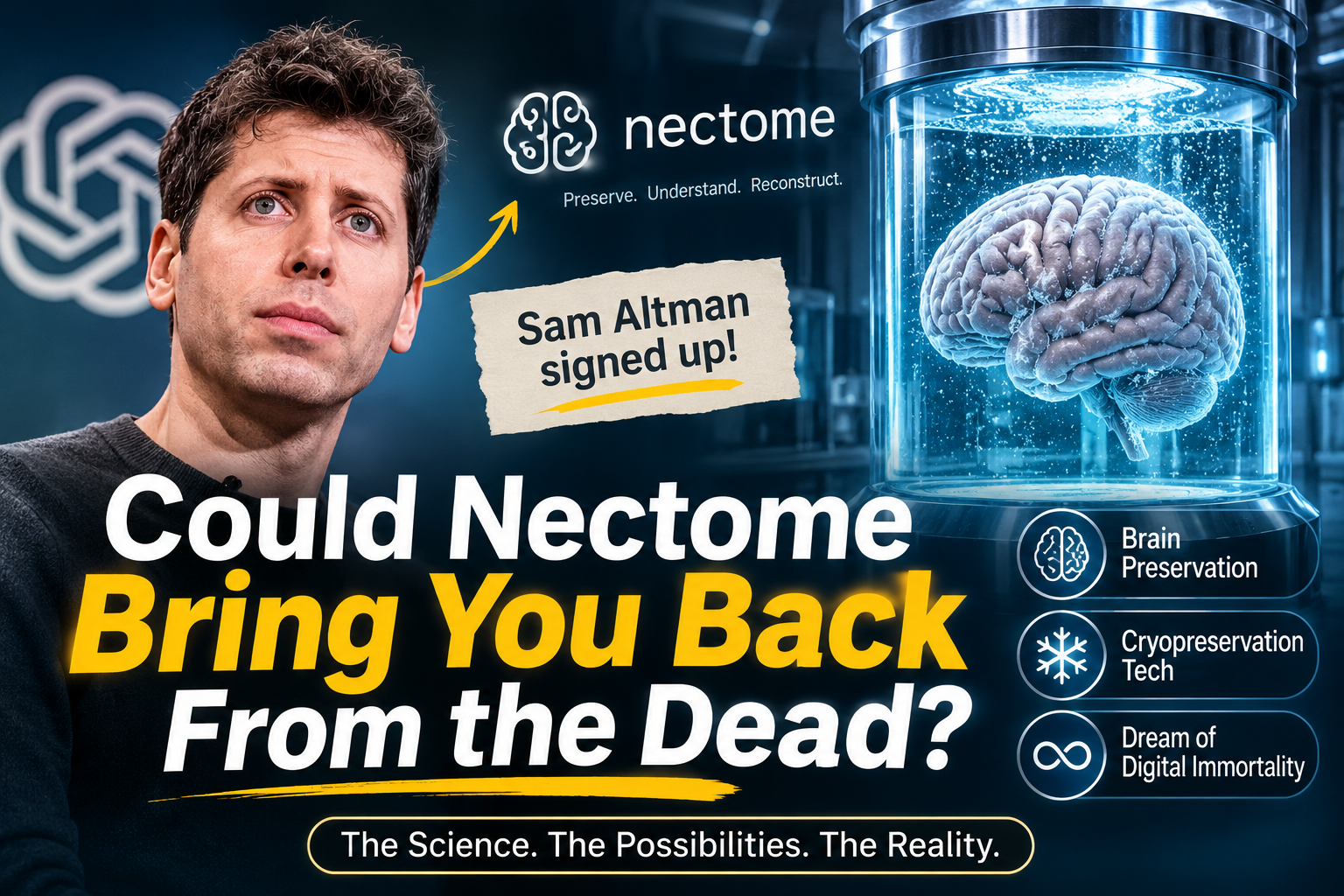
The company made headlines in 2018 when reports revealed that Sam Altman, the OpenAI CEO, had joined its waiting list for a brain-preservation service. He was reportedly among approximately 25 people who had placed a refundable $10,000 deposit.
The idea was extraordinary: preserve a person's brain in such fine detail that future technology might be able to reconstruct the information stored inside it.
But there was a disturbing complication. The original procedure was described as 100% fatal.
Nearly a decade later, Nectome has a different preservation approach. So what exactly is it trying to achieve, and how much of this is actually supported by science?
What is Nectome?
Nectome is a human-preservation company working on technologies intended to preserve the brain and body after death, with the hope that future science might eventually make revival possible.
Its central scientific idea is that memories and aspects of personality may be encoded in the physical structure of the brain.
The brain contains approximately 86 billion neurons, connected through an enormous network of synapses. These connections form circuits involved in memory, learning, behaviour and other aspects of brain function.
This network is often called the connectome.
Nectome's ambition is to preserve this biological architecture at an exceptionally fine level of detail. If the relevant structures and molecular information survive, the company believes future technologies might be able to use that information to reconstruct a person.
However, preserving a brain's physical structure and bringing its owner back to life are two very different scientific achievements.
Why did Sam Altman sign up?
In 2018, Nectome attracted international attention after reporting by MIT Technology Review and other publications revealed that Sam Altman had joined its early waiting list.
The reported arrangement involved a refundable deposit of approximately $10,000. Altman was among a small group of people interested in the possibility of preserving their brains for future technologies.
This was not evidence that he had undergone the procedure, nor did it mean that Nectome could guarantee future revival.
The attraction was the possibility of a future in which advances in neuroscience, computing and artificial intelligence might make it possible to interpret the information preserved in a human brain.
For someone interested in the long-term future of AI, the idea raises a fascinating question:
Could a sufficiently advanced computer eventually recreate a human mind from the physical information stored in a brain?
That remains an open scientific and philosophical question.
How does Nectome preserve a brain?
One of the technologies associated with Nectome is called aldehyde-stabilized cryopreservation (ASC).
The method combines chemical fixation with cryopreservation.
In simplified terms, it works through two major processes:
1. Chemical fixation
A chemical fixative, such as glutaraldehyde, is introduced into the brain through its blood vessels. It stabilises proteins and other cellular structures, helping preserve the microscopic architecture of the tissue.
This is important because the arrangement of neurons, synapses and other cellular components may contain information relevant to understanding how the brain works.
2. Cryopreservation
A cryoprotectant is introduced to reduce damage associated with ice formation. The tissue can then be cooled into a vitrified state, in which it is stored without conventional ice-crystal formation.
The original ASC research demonstrated the preservation of rabbit and pig brains, with researchers using electron microscopy to examine their microscopic structures.
The study reported that neuronal processes and synapses remained clearly traceable.
This is meaningful progress in brain preservation research. But it is not the same as preserving a living, functioning brain.
A chemically fixed brain is not biologically alive. The method is designed to preserve structure, not maintain normal brain activity.
The original Nectome controversy: Why was the procedure called 100% fatal?
The company's early proposal attracted serious ethical criticism.
In its 2018 version, the preservation process required chemical fixation while the brain still had to be supplied with blood circulation. The original plan therefore involved a procedure that would cause death.
Nectome's founders openly acknowledged this, and the proposed approach was discussed in connection with physician-assisted dying.
The controversy became so significant that MIT ended a research collaboration associated with the project.
The concern was not simply whether the technology could preserve tissue. It was whether anyone should risk or end a human life for a procedure that offered no demonstrated possibility of revival.
That distinction matters enormously.
A preservation technology that might retain microscopic information is not a proven medical treatment, and it cannot be presented as a way to escape death.
What has changed in Nectome's newer approach?
Nectome's more recent work describes a different model: planned, whole-body preservation that takes place after legal death.
Rather than relying on the original procedure, the company is developing a post-mortem preservation protocol intended to preserve both the brain and the rest of the body.
In March 2026, Nectome researchers published a preprint describing experiments involving pig brains. They reported that their protocol could preserve brain structures at a level that allowed researchers to trace neuronal connections and examine synapses.
The work also investigated the time window after cardiac arrest in which preservation procedures need to begin.
The researchers estimated that the relevant perfusion window was approximately 14 minutes under the experimental conditions they studied.
This is an important technical constraint. It means that the company's approach requires advance planning rather than simply responding to an unexpected death.
There is an important qualification: the 2026 study was a preprint, not a completed demonstration of human preservation or revival. Its authors are affiliated with Nectome, so independent replication and further scientific scrutiny matter.
According to the company's November 2026 retrospective, it has completed a paid preservation of a family dog and is preparing to open its human-preservation operation in Oregon in January 2027.
That is a substantial development in the company's commercial plans, but it is not evidence that human preservation has already been successfully demonstrated by Nectome.
Could a preserved brain be uploaded into a computer?
This is where the story becomes particularly interesting.
The concept is often called mind uploading or whole-brain emulation.
The basic idea is to map the structure of a brain, understand how its components interact, and construct a computational model that reproduces its functions.
In theory, such a model might reproduce aspects of a person's memories, behaviour and personality.
But there are enormous scientific challenges.
First, scientists do not yet fully understand how memories are physically encoded and distributed across the brain.
Second, mapping every relevant connection is not necessarily enough. Neural function also depends on chemical signalling, changing electrical activity, receptor distributions, molecular states and interactions between different brain regions.
Third, even if scientists could construct a highly accurate computational model, an important philosophical question would remain:
Would that model actually be the original person, or would it simply be a convincing digital copy?
We do not currently have a scientific test that can settle that question.
Artificial intelligence may eventually help researchers analyse enormous quantities of brain data, model neural circuits and investigate the relationship between biological structures and cognition. But AI does not currently provide a way to reconstruct a deceased person's consciousness.
What does current science actually say?
Brain preservation is a legitimate area of scientific research. Cryobiology, connectomics and ultrastructural microscopy have all made meaningful contributions to understanding how biological structures can be preserved.
A 2015 paper on aldehyde-stabilized cryopreservation demonstrated detailed structural preservation in rabbit and pig brains.
A 2024 review, Structural brain preservation: a potential bridge to future medical technologies, discussed how preservation methods might help retain information relevant to future neuroscience.
Another 2024 scientific roadmap on biostasis examined the technical challenges involved in preserving humans and potentially restoring them in the future.
However, that literature also makes a crucial distinction: reversible human suspended animation is not currently possible, and future revival remains highly theoretical.
There is no demonstrated method to take a chemically fixed human brain, restore its biological function, recover its memories and bring its original owner back to life.
This is the gap between what Nectome is trying to preserve and what future science would need to accomplish.
Is this the beginning of digital immortality?
Not yet.
Nectome is pursuing an ambitious idea: that preserving enough of the brain's physical organisation today might give future generations the information needed to understand or reconstruct a person.
It is a fascinating research direction, especially as AI, neuroscience and advanced imaging continue to develop.
But there are three separate milestones:
Preservation: Retaining the relevant physical structures of a brain.
Reconstruction: Understanding and recreating the information represented by those structures.
Revival: Restoring the original person's consciousness and identity, or establishing that a reconstructed system genuinely represents them.
Progress in the first does not automatically solve the second or third.
Nectome's work belongs to the first milestone. The others remain unresolved.
Perhaps the most interesting part of this story is not whether someone will wake up in the year 2500. It is that scientists are beginning to investigate whether the physical information associated with a human mind can survive long after the person has died.
For now, Nectome is not selling immortality. It is betting that future science may discover what to do with a preserved human brain.
And that is a much bigger scientific gamble than it first appears.
References and further reading
Nectome – Official website: https://nectome.com/
Nectome Research: https://nectome.com/research/
Song A, Fahy GM. Aldehyde-stabilized cryopreservation. Cryobiology (2015). https://doi.org/10.1016/j.cryobiol.2015.09.003
Song A, LaVergne A, Wróbel B. Ultrastructural preservation of a whole large mammal brain with a protocol compatible with human physician-assisted death. bioRxiv (2026). https://doi.org/10.64898/2026.03.04.709724
McKenzie AT et al. Biostasis: A Roadmap for Research in Preservation and Potential Revival of Humans. Brain Sciences (2024). https://doi.org/10.3390/brainsci14090942
Structural brain preservation: a potential bridge to future medical technologies. Frontiers in Medical Technology (2024). https://doi.org/10.3389/fmedt.2024.1400615
Vanity Fair (2018). Tech Bros Are Lining Up to Have Their Brains Preserved Forever. https://www.vanityfair.com/news/2018/03/tech-bros-lining-up-to-have-their-brains-preserved-forever-nectome
Nectome (November 2026). Nectome 2026 retrospective. https://articles.nectome.com/p/nectome-2026-retrospective
Editorial note: This article is an independent science and technology explainer, not medical advice or an endorsement of Nectome. Its future-revival claims should be understood as speculative, not established medical science.