If you've searched for ways to stop hair loss, you've probably encountered two names repeatedly: minoxidil and finasteride.
Both are among the most researched treatments for hereditary pattern baldness. Both can help preserve hair. And both have helped many people manage progressive hair thinning.
But they work in completely different ways.
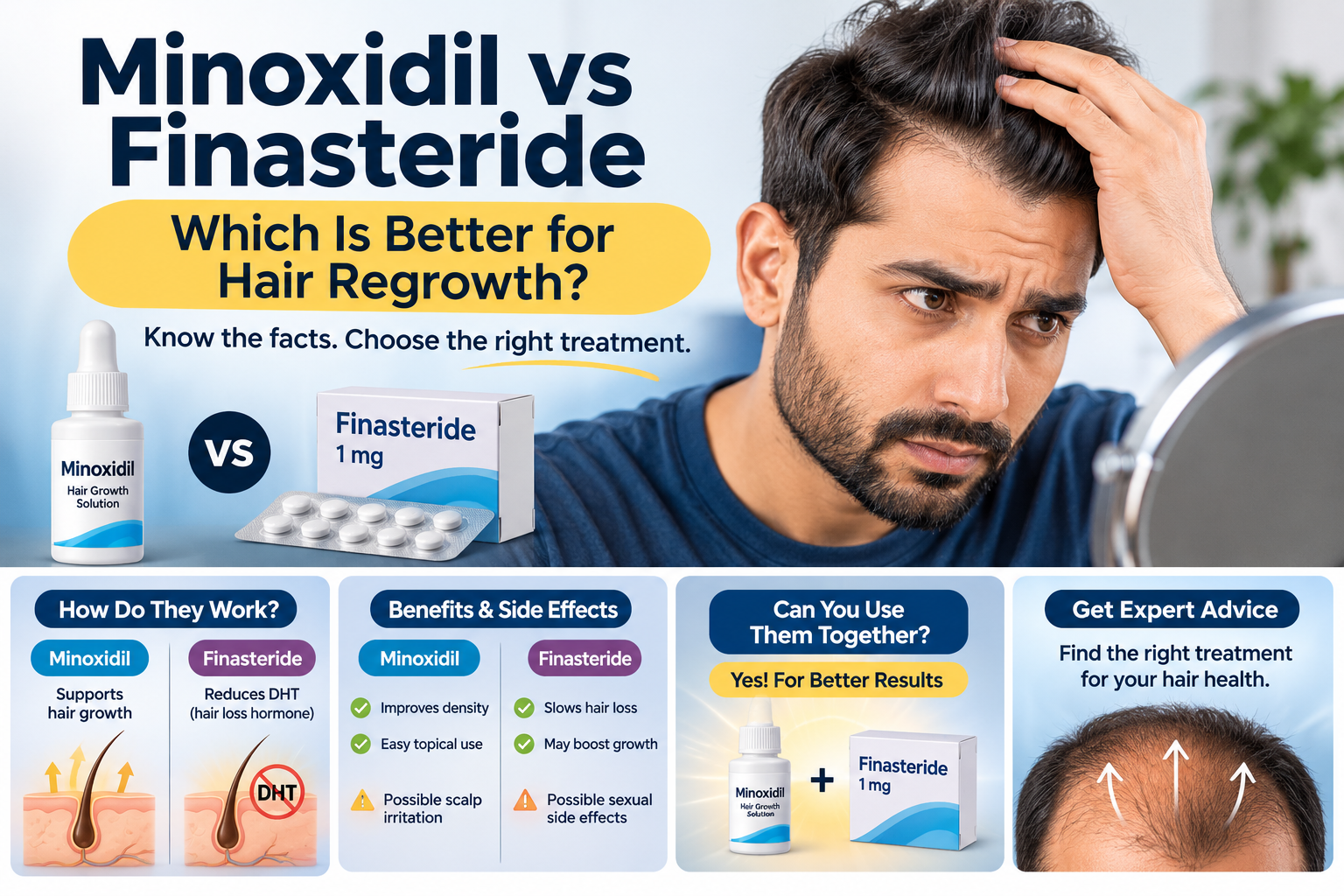
Minoxidil encourages hair follicles to remain in their growth phase, while finasteride targets a hormone associated with the gradual shrinking of susceptible hair follicles.
So which one should you choose? Is one more effective than the other? And can using both together produce better results?
Let's look at what the scientific evidence actually says.
First, understand why your hair is falling out
Before comparing treatments, it is important to understand androgenetic alopecia, commonly called male or female pattern hair loss.
In genetically susceptible individuals, hair follicles gradually become smaller through a process called follicular miniaturisation.
In men, this process is strongly influenced by dihydrotestosterone (DHT), a hormone produced from testosterone.
Over time, affected follicles produce progressively thinner and shorter hairs. The hairline may recede, the crown may become thinner, and eventually some follicles may stop producing visible hair.
This is where minoxidil and finasteride take different approaches.
1. Minoxidil: Encouraging hair growth
Minoxidil was originally developed as a medicine for high blood pressure. Researchers discovered that increased hair growth could occur as a side effect.
Today, topical minoxidil is an established treatment for pattern hair loss.
It is commonly available as a 2% or 5% solution or foam, depending on the product and the patient.
How does minoxidil work?
The exact mechanism is not completely understood. However, minoxidil appears to influence hair follicle activity, prolong the growth phase of hair and support the enlargement of miniaturised follicles.
In practical terms, it may help:
- Increase hair density.
- Improve the thickness of existing hair.
- Slow down visible thinning.
- Stimulate some regrowth in affected areas.
It does not directly block DHT, which is an important distinction when comparing it with finasteride.
How long does minoxidil take to work?
Hair growth is a slow biological process.
Some people notice changes after three to four months, but a more meaningful assessment generally requires six to twelve months of consistent use.
Temporary increased shedding can occur when treatment begins. This can be unsettling, but it does not necessarily mean the treatment is failing.
Minoxidil side effects
Topical minoxidil is generally well tolerated, but possible side effects include:
- Scalp irritation, itching or dryness.
- Unwanted facial hair growth if the product spreads beyond the scalp.
- Temporary increased shedding.
- Rarely, dizziness, palpitations or swelling, which require medical assessment.
Using more product than directed does not produce faster results and may increase the risk of adverse effects.
One important limitation: when minoxidil is discontinued, the hair maintained or gained through treatment is generally lost gradually over the following months.
2. Finasteride: Reducing the hormone associated with baldness
Finasteride works at a different level.
It is an oral prescription medicine commonly used for male pattern hair loss.
How does finasteride work?
The body converts testosterone into DHT using an enzyme called 5-alpha-reductase.
Finasteride inhibits the type II form of this enzyme, reducing DHT production.
Because DHT contributes to follicular miniaturisation in genetically susceptible people, reducing its levels can slow the progression of hereditary hair loss.
Clinical studies have shown that finasteride can help preserve existing hair, and some patients experience increased hair growth.
How effective is finasteride?
The American Academy of Dermatology reports that finasteride slows further hair loss in approximately 80–90% of men taking it.
However, individual responses vary. Some people primarily experience stabilisation, while others achieve visible improvement in hair density.
It is generally more useful when started before extensive follicular loss has occurred.
Finasteride side effects
Finasteride requires careful consideration because it affects hormone metabolism.
Reported adverse effects include:
- Reduced sexual desire.
- Erectile dysfunction.
- Ejaculation-related problems.
- Breast tenderness or enlargement.
- Mood changes, including depression.
Regulatory authorities have also highlighted concerns about suicidal thoughts associated with finasteride tablets. Anyone experiencing significant mood changes or suicidal thoughts should seek medical help promptly.
Some patients have reported persistent sexual symptoms after discontinuing treatment. These concerns should be discussed with a doctor before starting.
Finasteride is not appropriate for everyone, and its benefits must be weighed against potential risks.
Pregnant women must not use finasteride because it can interfere with the development of external genitalia in a male fetus. Pregnant women should not handle crushed or broken tablets.
## 3. Minoxidil vs Finasteride: Which is more effective?
This is the question most people want answered.
The treatments have different mechanisms, so the better option depends on the type and extent of hair loss, the person's health and their treatment goals.
A 2025 network meta-analysis compared different treatments for male pattern hair loss. Among the FDA-approved treatments it evaluated, topical minoxidil 5% performed best among topical options, while oral finasteride 1 mg performed best among oral options.
This does not mean one is universally better than the other. The analysis compared evidence from multiple studies, rather than one large trial directly comparing every treatment under identical conditions.
Here is a practical comparison:
| Feature | Minoxidil | Finasteride |
|---|---|---|
| Main action | Supports hair growth | Reduces DHT production |
| Common form | Topical solution or foam | Oral prescription tablet |
| Main benefit | Can improve hair density | Can slow hereditary hair loss |
| Typical assessment period | 6–12 months | 6–12 months |
| Main concerns | Scalp irritation, unwanted hair growth | Sexual and possible mood-related effects |
| Long-term use | Usually needed | Usually needed |
The important takeaway is that minoxidil supports the growth of hair, while finasteride helps reduce one of the underlying hormonal drivers of male pattern baldness.
4. Can you use minoxidil and finasteride together?
Yes. Dermatologists sometimes prescribe both because they work through different mechanisms.
Minoxidil supports hair growth, while finasteride reduces DHT-related follicular miniaturisation.
A 2025 systematic review and meta-analysis of seven randomised controlled trials involving 396 men found that topical minoxidil combined with topical finasteride produced better hair-density and hair-diameter outcomes than minoxidil alone.
However, the studies were relatively small, and longer-term research is still needed.
Combination treatment is not automatically appropriate for everyone. Finasteride-related risks remain relevant, including when a topical formulation is used. Topical application does not guarantee zero absorption into the bloodstream.
A dermatologist can help determine whether combination treatment offers a meaningful advantage in an individual case.
5. What about women experiencing hair loss?
Female pattern hair loss is different in some important respects, and treatment choices need to account for pregnancy potential and other medical factors.
Topical minoxidil is an established treatment for female pattern hair loss.
Finasteride, however, is not routinely approved for female pattern hair loss in many countries and must not be used during pregnancy. Specialists may consider selected off-label approaches in certain patients, depending on their circumstances.
Women experiencing sudden shedding, irregular periods, acne, excessive facial hair or other hormonal symptoms should be evaluated for possible underlying causes rather than assuming all hair loss is hereditary.
6. What happens if you stop treatment?
Neither treatment permanently eliminates the underlying genetic tendency toward pattern baldness.
If you stop minoxidil, the hair growth benefits are generally lost gradually.
If you stop finasteride, DHT levels return towards their previous levels, and the protective effect against further hair loss is lost over time.
This means both treatments usually require ongoing use to maintain their benefits.
It is worth understanding this before starting either medicine, particularly if you expect a short course to produce permanent results.
7. Which treatment should you choose?
There is no universal answer, but the following distinctions can help:
- Early hereditary thinning: A dermatologist may consider topical minoxidil, finasteride or both, depending on the patient's circumstances.
- Receding hairline and crown thinning: Finasteride may be particularly useful for slowing DHT-driven progression in eligible men.
- People who prefer a topical treatment: Minoxidil is an established option, although it requires regular application.
- People concerned about finasteride side effects: Discuss the risks, alternatives and expected benefits with a dermatologist rather than starting it independently.
- Sudden or patchy hair loss: Get the cause diagnosed first. Minoxidil and finasteride are not universal treatments for every type of hair loss.
Remember that treating hereditary baldness is different from treating hair shedding caused by iron deficiency, thyroid disease, stress or autoimmune conditions.
## Final thoughts: The best hair-loss treatment is the one that targets the actual cause
Minoxidil and finasteride are not miracle cures, but they represent two important approaches to treating hereditary hair loss.
Minoxidil helps support hair growth. Finasteride reduces DHT production, which can slow the process responsible for follicular miniaturisation in susceptible men.
For some patients, combining the two may offer better results than using minoxidil alone.
But starting treatment without understanding the cause of hair loss can waste time and money, and may expose someone to unnecessary medication risks.
If you are noticing a receding hairline or thinning crown, consider seeing a dermatologist early. Protecting existing follicles is often more realistic than trying to restore hair after extensive loss.
**The science of hair restoration is not about finding one magic product. It is about identifying the right biological target and treating it consistently.**
---
### References and further reading
1. American Academy of Dermatology. What is male pattern hair loss, and can it be treated? https://www.aad.org/public/diseases/hair-loss/treatment/male-pattern-hair-loss-treatment
2. Gupta AK et al. Comparative Efficacy of Minoxidil and 5-Alpha Reductase Inhibitors Monotherapy for Male Pattern Hair Loss: Network Meta-Analysis Study of Current Empirical Evidence. Journal of Cosmetic Dermatology, 2025. https://doi.org/10.1111/jocd.70320
3. Gupta AK et al. Relative Efficacy of Minoxidil and the 5-α Reductase Inhibitors in Androgenetic Alopecia Treatment of Male Patients: A Network Meta-analysis. JAMA Dermatology, 2022. https://doi.org/10.1001/jamadermatol.2021.5743
4. American Academy of Family Physicians. Hair Loss: Diagnosis and Treatment. 2024. https://www.aafp.org/afp/2024/0900/hair-loss
5. US Food and Drug Administration. Propecia (finasteride) prescribing information. https://www.accessdata.fda.gov/drugsatfda_docs/label/2022/020788s030lbl.pdf
6. Comparing minoxidil-finasteride mixed solution with minoxidil solution alone for male androgenetic alopecia: A systematic review and meta-analysis of randomized controlled trials. Frontiers in Medicine, 2025. https://doi.org/10.3389/fmed.2025.1632139
*Medical disclaimer: This article is for educational purposes and does not replace individual medical advice. Finasteride and oral minoxidil require medical assessment. Consult a qualified dermatologist before starting, changing or stopping hair-loss medication.*
:::
Minoxidil vs Finasteride: Which Is Better for Hair Regrowth?
V
By Vishal K
|
Tags:#minoxidil vs finasteride#minoxidil for hair growth#finasteride for hair loss#minoxidil side effects#finasteride side effects#hair regrowth treatment#minoxidil and finasteride together
V
Vishal K
Dedicated to providing trustworthy healthcare insights and professional advice.
0