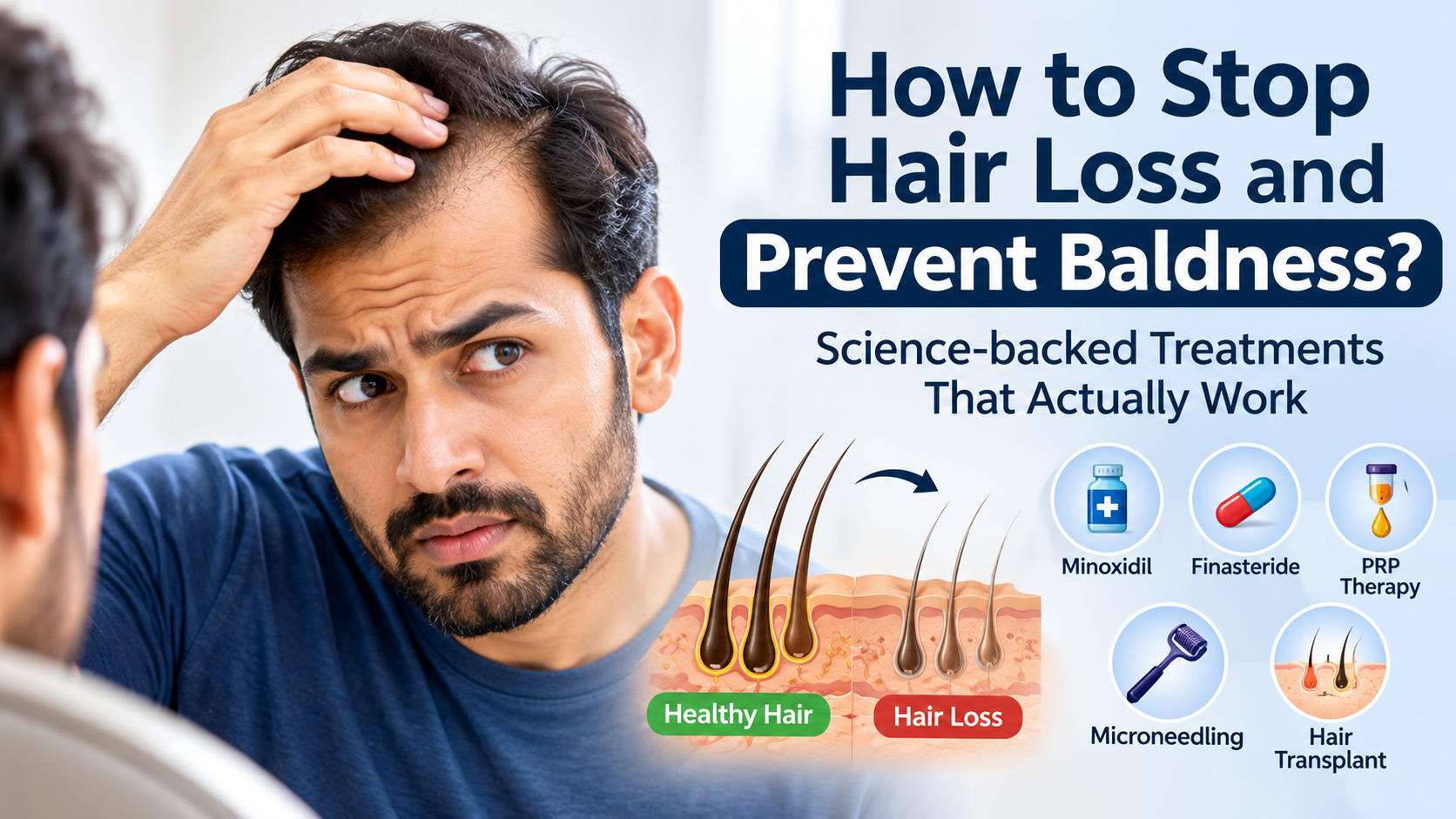
You notice more hair on your pillow. Your hairline looks slightly different in photographs. Your scalp seems more visible under bright light, and suddenly, every mirror becomes a reminder that something might be changing.
Hair loss is one of those concerns people often ignore until it becomes difficult to hide.
The internet offers countless solutions: special shampoos, oils, supplements, scalp massages, laser caps and expensive treatments promising to bring back lost hair. But how many of these actually work?
The science of hair restoration has advanced considerably. Although there is no universal cure for baldness, several treatments can slow hair loss, improve hair density and, in some cases, stimulate regrowth.
The most important thing is understanding why your hair is falling out before choosing a treatment.
Why do people lose their hair?
Hair loss is not one disease. It is a symptom that can have several different causes.
1. Genetics and male pattern baldness
The most common cause of progressive hair loss in men is androgenetic alopecia, commonly known as male pattern baldness.
It is influenced by genetics and hormones, particularly dihydrotestosterone (DHT), which is produced from testosterone by an enzyme called 5-alpha-reductase.
In genetically susceptible individuals, DHT gradually causes certain scalp hair follicles to shrink. This process is called follicular miniaturisation.
Over time:
Hair strands become thinner.
The growth phase of hair becomes shorter.
The hairline may recede.
Thinning can develop around the crown.
Eventually, some affected follicles produce barely visible hair.
This is why hereditary baldness can progress even when someone eats well, exercises regularly and maintains good hygiene.
It can begin in the late teens or twenties, although progression varies considerably between individuals.
2. Stress and sudden hair shedding
Have you ever noticed unusually heavy hair shedding a few months after an illness, major stress or surgery?
This may be telogen effluvium.
Normally, hair follicles move through growth, transition and resting phases. A physical or psychological stressor can push a larger-than-usual proportion of follicles into the resting phase, followed by increased shedding.
Possible triggers include:
High fever or severe illness.
Surgery.
Significant emotional or physical stress.
Rapid weight loss or restrictive dieting.
Childbirth.
Certain medications.
Nutritional deficiencies.
Unlike hereditary pattern baldness, telogen effluvium is often temporary. Hair growth may recover once the trigger is addressed, although recovery can take several months.
3. Nutritional deficiencies and medical conditions
Hair follicles require adequate nutrition and a healthy hormonal environment.
Iron deficiency, thyroid disorders and inadequate nutritional intake can contribute to hair loss.
However, taking supplements without identifying a deficiency is not necessarily helpful. Excessive intake of certain nutrients, including vitamin A and selenium, can itself contribute to hair loss.
A doctor may recommend blood tests based on the pattern of shedding, medical history and examination.
4. Autoimmune conditions
Alopecia areata is an autoimmune condition in which the immune system attacks hair follicles.
It commonly causes sudden, smooth, round or oval bald patches. In some people, it can affect larger areas of the scalp or body.
Its treatment is different from hereditary baldness and may involve corticosteroids or other immune-targeting medicines.
This is why identifying the type of hair loss matters.
Can you actually prevent baldness?
The answer depends on the cause.
You cannot completely eliminate inherited susceptibility to pattern baldness through diet, shampoo or lifestyle changes.
However, early treatment can often slow its progression and preserve existing hair.
For other forms of hair loss, such as temporary shedding caused by iron deficiency, thyroid disorders or a stressful event, treating the underlying cause may allow hair to recover.
The earlier the correct diagnosis is made, the better the opportunity to protect hair that is still present.
Hair loss treatments: What does science actually support?
Let's look at the major treatments, from established medications to newer procedures.
1. Minoxidil: One of the most established hair-growth treatments
Minoxidil is a widely used treatment for hereditary pattern hair loss.
It is available as a topical solution or foam, commonly in 2% and 5% formulations, depending on the product and patient.
Although the exact biological mechanisms are not fully understood, minoxidil can prolong the hair-growth phase and improve the size and activity of miniaturised follicles.
Research shows that it can:
Slow hair thinning.
Improve hair density.
Stimulate some regrowth.
Help preserve existing hair.
However, results take time. Many people need around six to twelve months to assess the full benefit.
Some people experience temporary increased shedding when beginning treatment. Scalp irritation and unwanted facial hair growth are other possible side effects.
An important limitation: minoxidil is a maintenance treatment. If it is stopped, the benefits gradually disappear and hair loss may resume.
2. Finasteride: Targeting the hormone behind pattern baldness
Finasteride works differently from minoxidil.
It inhibits the type II 5-alpha-reductase enzyme, reducing the conversion of testosterone into DHT.
Because DHT contributes to follicle miniaturisation in susceptible individuals, reducing its production can slow male pattern baldness.
Clinical evidence supports finasteride for men with androgenetic alopecia. Some men experience stabilisation of hair loss, while others also see increased hair growth.
However, finasteride is a prescription medicine and is not suitable for everyone.
Possible adverse effects include:
Reduced sexual desire.
Erectile or ejaculatory problems.
Breast tenderness or enlargement.
Mood changes, including depression.
Some people have reported persistent symptoms after stopping treatment. These risks should be discussed with a qualified doctor before starting.
Finasteride also carries important pregnancy-related precautions because exposure can harm the development of a male fetus. Pregnant women should not handle crushed or broken tablets.
Minoxidil and finasteride work through different mechanisms and are sometimes prescribed together. A dermatologist can determine whether the combination is appropriate.
3. Low-dose oral minoxidil
Minoxidil was originally developed as a blood-pressure medicine. Doctors later discovered that increased hair growth could occur as a side effect.
Low-dose oral minoxidil is now used by some dermatologists to treat hair loss, including cases where topical treatment is inconvenient or ineffective.
However, using oral minoxidil for hair loss is an off-label use in many countries.
Because it acts on blood vessels, it can cause unwanted effects such as:
Increased body or facial hair.
Fluid retention and swelling.
Changes in heart rate.
Dizziness or low blood pressure.
Rare but serious cardiovascular complications are possible.
It should never be treated as a simple hair-growth supplement. Medical assessment and appropriate monitoring are important.
4. PRP therapy: Can your own blood help regrow hair?
Platelet-rich plasma (PRP) therapy has attracted considerable attention in hair restoration.
The procedure generally involves:
Collecting a small amount of the patient's blood.
Processing it in a centrifuge to concentrate platelets.
Injecting the platelet-rich plasma into selected areas of the scalp.
Platelets contain growth factors involved in tissue repair and cellular signalling. Researchers are investigating whether these factors can influence hair follicle activity.
Clinical studies and systematic reviews suggest that PRP may improve hair density in some people with androgenetic alopecia.
However, treatment protocols differ considerably between clinics and studies. The number of sessions, platelet concentration and injection methods are not standardised everywhere.
PRP is therefore a promising option, but it is not a guaranteed cure. Results can vary, and maintenance sessions may be recommended.
5. Microneedling: Creating controlled stimulation in the scalp
Microneedling uses tiny needles to create controlled micro-injuries in the skin.
Researchers believe this process may activate wound-healing pathways and growth-factor signalling that can support hair growth.
Some clinical studies have found better results when microneedling is combined with topical minoxidil than when minoxidil is used alone.
However, evidence is still developing, and the ideal treatment depth and frequency remain uncertain.
Improper home use can cause infection, irritation, scarring or worsening of existing scalp conditions.
It is better to discuss this procedure with a dermatologist rather than experimenting with unregulated devices.
6. Low-level laser therapy
Low-level laser therapy (LLLT), sometimes called red-light therapy, uses devices that deliver specific wavelengths of light to the scalp.
Some clinical studies suggest that these devices may improve hair density in people with hereditary hair loss.
However, results are not universal, and the long-term evidence is less extensive than that for established medicines.
Laser caps and combs can also be expensive. Before purchasing one, check whether the device has appropriate regulatory clearance for its intended use and whether the evidence supports the specific product.
7. Hair transplantation: Moving follicles rather than creating new ones
Hair transplantation is a surgical procedure in which hair follicles are taken from a donor area, usually the back or sides of the scalp, and implanted into thinning or bald areas.
Two commonly discussed techniques are:
FUE (Follicular Unit Extraction): Individual follicular units are extracted and transplanted.
FUT (Follicular Unit Transplantation): A strip of scalp is removed and divided into follicular units for transplantation.
Transplanted follicles from suitable donor areas can continue producing hair in their new location.
However, transplantation does not stop the progression of hereditary hair loss in the surrounding, non-transplanted hair.
This means some people still need medical treatment to preserve their remaining hair.
A good transplant depends on donor hair availability, surgical planning, realistic expectations and an experienced medical team.
What about natural oils, shampoos and hair-growth supplements?
This is where marketing often gets ahead of science.
Rosemary oil, onion juice, caffeine shampoos, biotin supplements and various herbal products are frequently advertised as solutions for baldness.
Some ingredients have preliminary research, but the evidence is generally much weaker than for established treatments such as topical minoxidil.
A few important distinctions:
Biotin: Supplementation is useful when a deficiency exists, but there is limited evidence that extra biotin improves hair growth in people who already have adequate levels.
Hair oils: They may improve hair conditioning and reduce breakage, but they cannot reliably reverse genetically driven follicle miniaturisation.
Anti-hair-fall shampoos: They can help maintain scalp hygiene or treat certain scalp conditions, but ordinary shampoos do not reverse hereditary baldness.
Herbal supplements: Products marketed for DHT blocking or hair regrowth often lack convincing clinical evidence. Some may interact with medicines.
Do not confuse healthier-looking hair with the restoration of lost follicles.
A practical approach: What should you do when hair loss begins?
Instead of immediately buying multiple products, start with the following steps.
Step 1: Identify the pattern.
Is your hairline receding? Is the crown thinning? Are you shedding hair from all over your scalp? Are there sudden bald patches?
Different patterns suggest different causes.
Step 2: Get the cause assessed.
A dermatologist may examine the scalp using dermoscopy or trichoscopy. Depending on the findings, blood tests for iron status, thyroid function or other conditions may be appropriate.
Step 3: Start treatment based on the diagnosis.
For hereditary pattern hair loss, topical minoxidil and prescription treatments such as finasteride may be considered. Other conditions require different therapies.
Step 4: Track progress realistically.
Take photographs under similar lighting and at similar angles every few months. Hair growth is slow, and daily mirror comparisons can be misleading.
Step 5: Be consistent and patient.
Most established treatments require several months before meaningful results can be assessed. Discuss ongoing treatment and side effects with your doctor.
Is there a permanent cure for baldness?
For hereditary pattern baldness, there is currently no universally effective permanent cure that restores every lost follicle and prevents future progression.
Available treatments mainly aim to slow hair loss, increase the thickness of existing hair or redistribute healthy follicles through transplantation.
But the future of hair restoration is an active area of research.
Scientists are investigating hair follicle stem cells, regenerative medicine, cellular signalling pathways and methods of creating or regenerating functional hair follicles.
These approaches are scientifically interesting, but experimental findings should not be confused with treatments that are proven and routinely available to patients.
The most reliable strategy today is still early diagnosis, evidence-based treatment and realistic expectations.
Final thoughts
Hair loss can affect confidence, appearance and emotional well-being. But it is not something that should automatically lead to expensive procedures or unproven remedies.
A receding hairline may be hereditary. Sudden shedding may be temporary. Patchy hair loss may be autoimmune. Each requires a different approach.
The most important lesson is simple: don't wait until significant hair has disappeared before finding out why it is falling.
Modern treatments cannot promise a full head of hair for everyone, but the right diagnosis and timely treatment can make a meaningful difference.
References and further reading
American Academy of Dermatology. Hair loss: Diagnosis and treatment. https://www.aad.org/public/diseases/hair-loss/treatment/diagnosis-treat
American Academy of Dermatology. What is male pattern hair loss, and can it be treated? https://www.aad.org/public/diseases/hair-loss/treatment/male-pattern-hair-loss-treatment
Indian Council of Medical Research. Standard Treatment Workflow: Alopecia / Hair Loss. https://www.icmr.gov.in/icmrobject/uploads/STWs/1725967368_alopecia.pdf
Li J et al. Male and female pattern hair loss. Therapeutic Guidelines, 2025. https://pmc.ncbi.nlm.nih.gov/articles/PMC12187474/
Local Injection versus Topical Microneedling of Platelet-Rich Plasma for Androgenetic Alopecia: A Systematic Review. Archives of Plastic Surgery, 2025. https://pmc.ncbi.nlm.nih.gov/articles/PMC11896732/
US Food and Drug Administration. Potential risks associated with compounded topical finasteride products. https://www.fda.gov/drugs/human-drug-compounding/fda-alerts-health-care-providers-compounders-and-consumers-potential-risks-associated-compounded
Medical disclaimer: This article is for educational purposes and is not a substitute for individual medical advice. Hair-loss treatments, particularly prescription medicines and procedures, should be discussed with a qualified dermatologist.