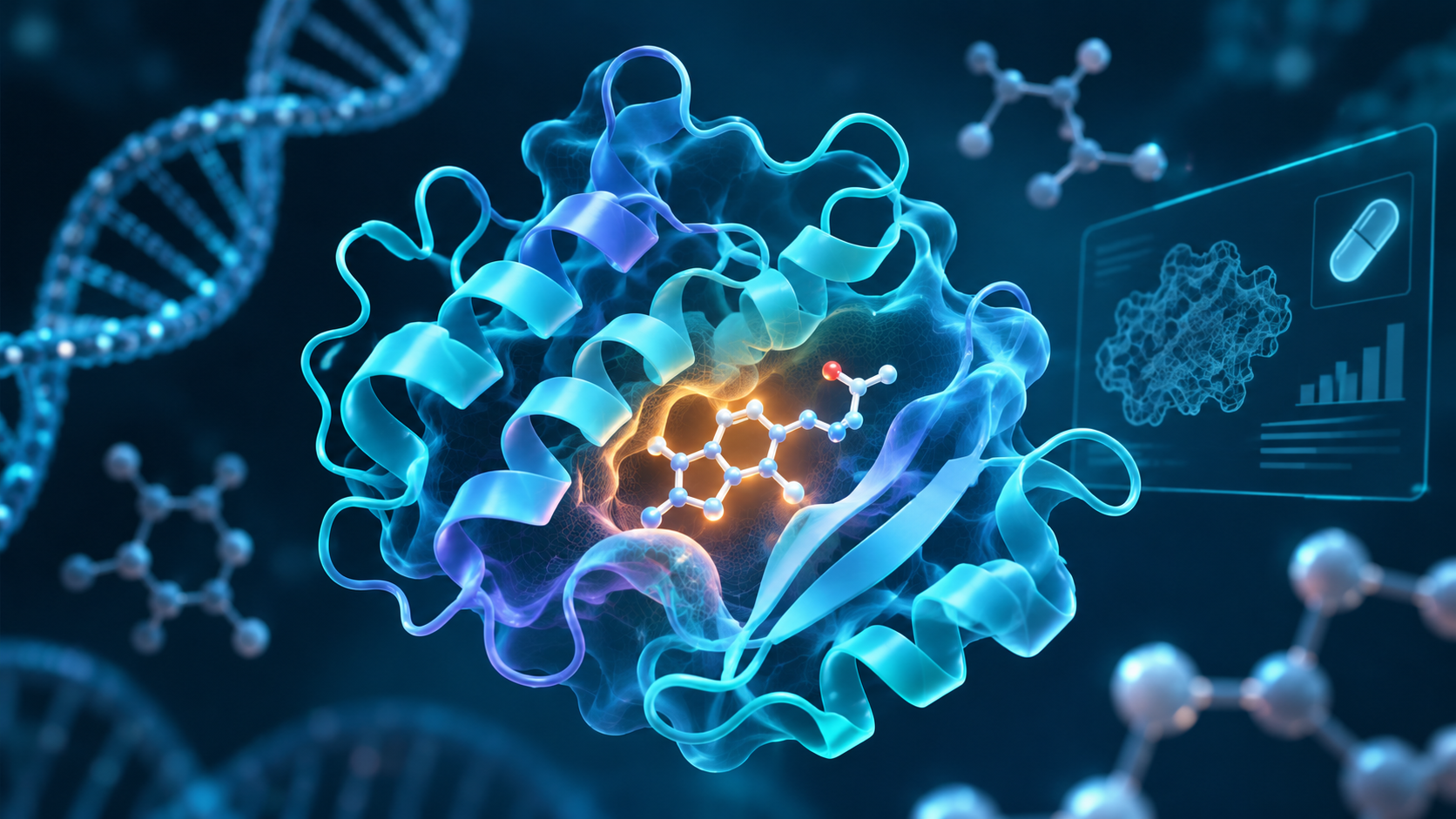
What if scientists could understand how a disease-related protein behaves, identify the molecules that might interact with it and explore potential drug candidates using artificial intelligence? This is the direction Google DeepMind is helping to advance. Through its AlphaFold models and its collaboration with Isomorphic Labs, the company has opened new possibilities in biological research and computational drug discovery. What makes this development exciting is that AI is moving beyond analysing medical information—it is beginning to help scientists understand the molecular machinery behind diseases and design potential medicines.
1. The problem scientists have been trying to solve
Every disease involves biological processes occurring inside our bodies. Proteins, DNA, RNA and other molecules interact continuously to maintain cellular functions.
When these processes malfunction, disease can develop.
For pharmaceutical researchers, understanding the three-dimensional structure of proteins is particularly important. A protein's shape influences how it functions and how other molecules interact with it.
Traditionally, determining protein structures experimentally has required sophisticated techniques such as X-ray crystallography, nuclear magnetic resonance and cryo-electron microscopy.
These methods remain essential, but they can require substantial time, expertise and resources.
Understanding protein structures is also important in drug discovery because many medicines work by interacting with specific biological targets.
This is where Google DeepMind made one of its most significant contributions to computational biology.
2. AlphaFold: A breakthrough in understanding the human body
In 2020, Google DeepMind introduced AlphaFold 2, an artificial intelligence system capable of predicting protein structures from their amino acid sequences.
Proteins are made from chains of amino acids that fold into complex three-dimensional shapes. Predicting these shapes had been a longstanding scientific challenge.
AlphaFold 2 demonstrated remarkable accuracy in the 2020 Critical Assessment of Structure Prediction (CASP14) competition.
In 2021, its methodology was published in Nature, and the AlphaFold Protein Structure Database was subsequently developed in collaboration with EMBL's European Bioinformatics Institute.
The database now provides access to more than 200 million predicted protein structures.
This is significant because researchers no longer need to experimentally determine every protein structure before beginning computational investigations.
Scientists can use these predictions to investigate disease-associated proteins, understand mutations and develop hypotheses for further laboratory research.
In 2024, Demis Hassabis and John Jumper received the Nobel Prize in Chemistry, alongside David Baker, for contributions to computational protein structure prediction and protein design.
Scientific reference: Jumper et al. (2021), Highly accurate protein structure prediction with AlphaFold, Nature.
https://doi.org/10.1038/s41586-021-03819-2
3. AlphaFold 3: Moving from protein structures to molecular interactions
In May 2024, Google DeepMind and Isomorphic Labs introduced AlphaFold 3.
This was an important advancement because biological processes do not depend on isolated proteins. Molecules constantly interact with one another.
AlphaFold 3 can predict the structures of molecular complexes involving:
Proteins.
DNA.
RNA.
Small molecules, including drug-like ligands.
Ions.
Chemically modified biological molecules.
Why does this matter for medicine?
Imagine researchers investigating a protein associated with a particular disease. They want to understand whether a small chemical molecule could bind to that protein and potentially alter its activity.
AlphaFold 3 can help predict how these molecules may interact in three-dimensional space.
The model uses a diffusion-based architecture to generate molecular structures.
In the research published in Nature, the authors reported substantial improvements over previous specialised methods for several types of molecular interaction prediction.
However, predicting that a molecule can bind to a protein does not establish that it will become an effective medicine. Researchers must still investigate binding strength, selectivity, biological activity, toxicity and other properties experimentally.
The significance of AlphaFold 3 is that it gives scientists a more comprehensive computational view of molecular interactions.
Scientific reference: Abramson et al. (2024), Accurate structure prediction of biomolecular interactions with AlphaFold 3, Nature.
https://doi.org/10.1038/s41586-024-07487-w
4. Isomorphic Labs: Taking AI towards actual drug discovery
One particularly interesting development is Isomorphic Labs, a drug-discovery company founded in 2021 as a spinout from Google DeepMind.
Although closely connected through its origins and scientific collaboration, Isomorphic Labs is a separate company, not simply another name for Google DeepMind.
Its mission is to use AI to transform how medicines are discovered and designed.
The company combines biological understanding, computational chemistry and machine learning to investigate potential drug candidates.
Its work goes beyond predicting protein structures. Drug discovery requires understanding several additional properties, including:
How strongly a molecule binds to its target.
Whether it interacts with unwanted biological targets.
How its chemical structure can be modified to improve performance.
Whether it has suitable pharmacological properties.
Whether it can eventually demonstrate acceptable safety and effectiveness.
In February 2026, Isomorphic Labs announced its Drug Design Engine, called IsoDDE.
The company reported that this proprietary system more than doubled AlphaFold 3's accuracy on a challenging protein-ligand structure prediction benchmark. It also reported improvements in binding-affinity prediction and the identification of previously unrecognised binding pockets.
These are promising computational results, although they are company-reported benchmarks rather than evidence of successful clinical treatments.
The development is particularly interesting because it demonstrates how the original AlphaFold breakthrough is evolving into a broader computational drug-design strategy.
Reference: Isomorphic Labs – The Drug Design Engine, February 2026.
5. What could this mean for patients?
The real significance of these developments lies in their potential applications in healthcare.
Cancer research: Many cancers involve abnormal proteins and signalling pathways. Improved molecular modelling could help researchers investigate disease-related targets and explore molecules that might interfere with harmful biological processes.
Neurological disorders: Conditions affecting the brain can involve complex molecular mechanisms. Better structural understanding may help researchers investigate proteins associated with neurodegenerative diseases.
Rare genetic diseases: Understanding how genetic mutations alter protein structures can help scientists investigate the biological consequences of certain inherited disorders.
Infectious diseases: AI-assisted molecular research can help scientists study viral proteins, bacterial targets and potential therapeutic interactions.
Drug resistance: Structural modelling can help researchers investigate how mutations change drug-target interactions and potentially contribute to treatment resistance.
These are research opportunities, not guarantees of new treatments. The actual clinical usefulness depends on experimental and clinical validation.
6. What makes this different from conventional AI in healthcare?
Most people associate medical AI with applications such as analysing X-rays, identifying abnormalities in scans or predicting disease risk.
AlphaFold represents a different application.
Instead of primarily analysing medical images or patient records, it helps scientists investigate the molecular structures and interactions underlying biological processes.
It is essentially bringing computational intelligence into fundamental biological research.
Another important advantage is accessibility. Google DeepMind and EMBL-EBI have made the AlphaFold Protein Structure Database freely accessible to researchers worldwide. The AlphaFold Server also provides access to AlphaFold 3 capabilities for eligible non-commercial research.
This allows researchers, including those at universities and institutions with limited computational resources, to investigate molecular questions that previously required substantial specialised infrastructure.
Official research resources:
7. The reality check: AI has not eliminated the difficulty of developing medicines
Despite the excitement, discovering a promising molecular interaction is only one stage of pharmaceutical development.
A potential drug must undergo extensive investigations involving:
Laboratory validation.
Pharmacological testing.
Toxicity and safety studies.
Preclinical evaluation.
Clinical trials.
Regulatory assessment.
A molecule that looks promising computationally may fail in laboratory experiments. Even molecules that demonstrate promising biological activity may not be safe or effective in humans.
This is why AlphaFold and Isomorphic Labs should be viewed as important developments in scientific research rather than proof that AI can independently create successful medicines.
The real test will be whether AI-designed drug candidates can demonstrate meaningful safety and effectiveness in clinical trials.
Conclusion: The next pharmaceutical breakthrough may begin with a prediction
Google DeepMind's contribution to biological research demonstrates how artificial intelligence can help scientists investigate some of the most complicated systems in nature.
AlphaFold 2 transformed protein structure prediction. AlphaFold 3 expanded this capability to molecular interactions. Isomorphic Labs is now taking these advances further through computational drug design.
For patients, these developments offer a reason for optimism, particularly in areas where understanding biological targets has historically been difficult.
But the journey from an AI prediction to an approved medicine remains long and scientifically demanding.
The most exciting possibility is not that artificial intelligence will replace pharmaceutical scientists. It is that scientists may soon have computational tools powerful enough to explore biological possibilities that were previously too difficult, expensive or time-consuming to investigate.
And that could fundamentally change how humanity approaches the discovery of new medicines.
References and further reading
Jumper et al. (2021). Highly accurate protein structure prediction with AlphaFold – Nature.
Abramson et al. (2024). Accurate structure prediction of biomolecular interactions with AlphaFold 3 – Nature.
Nature – Isomorphic Labs' new AI drug-design model, February 2026.
Editorial note: This is an independent educational article. Google DeepMind and Isomorphic Labs are discussed for their scientific contributions; this article is not sponsored by or affiliated with either organisation.
Medical disclaimer: This article discusses research technologies and potential medical applications. It does not constitute medical advice or claim that AI-generated drug candidates are clinically approved or effective.